New Isles: A New Beginning/Chapter Twenty- The Hidden Story

The next morning, Hope Isles woke slowly.

The harbor stirred to life.

Fishing boats slipped into the water.

The aroma of fresh coffee drifted from Sit Awhile.

Church bells rang in the distance.

And for the first time in decades, Daniel Carter woke up on the island he once swore he’d never see again.

James found him sitting on the porch of Hope House before sunrise.

Coffee cup in hand.

Bible open.

Reading.

The sight made James smile.

“Couldn’t sleep?”

Daniel looked up.

“A little.”

James sat beside him.

“Bad memories?”

Daniel shook his head.

“Good ones.”

That answer surprised them both.

For years, Hope Isles had only represented loss.

Now something else was beginning to emerge.

Gratitude.

Healing had a way of changing the lens through which people viewed the past.

A few hours later, Walter arrived carrying a weathered leather satchel.

June noticed immediately.

“Oh no.”

Walter raised an eyebrow.

“Oh no what?”

June pointed at the satchel.

“That bag contains either wisdom or trouble.”

Walter laughed.

“Maybe both.”

Ethan leaned over.

“Definitely both.”

The group gathered around one of the large tables inside Hope House.

Walter carefully placed the satchel in front of him.

Then he removed several old journals.

Photographs.

Documents.

Letters.

Items yellowed by time.

Daniel stared.

“What is all this?”

Walter smiled.

“The rest of the story.”

Silence settled across the room.

Walter opened one of the journals.

“This belonged to Reverend Samuel Hayes.”

James recognized the name.

The founder of Hope House.

The man whose photograph still hung in the main hallway.

Walter nodded toward the journal.

“He wrote everything down.”

Sarah leaned forward.

“Everything?”

“Almost.”

Walter carefully opened to a bookmarked page.

The room grew quiet.

He began reading.

“Today Thomas Carter approached me with an idea.”

“He believes Hope Isles needs a place where broken people can start over.”

“A place where no one walks alone.”

“A place built on faith, community, and second chances.”

James froze.

Daniel did too.

Walter continued.

“Thomas says every person deserves someone who believes redemption is possible.”

“I believe he is right.”

Walter closed the journal.

The room sat in stunned silence.

Finally Ethan spoke.

“Wait.”

Everyone looked at him.

“You’re saying Thomas Carter helped create Hope House?”

Walter smiled.

“He did more than help.”

Daniel’s eyes widened.

“What do you mean?”

Walter slid an old photograph across the table.

In it stood Reverend Hayes.

Beside him stood Thomas Carter.

Both smiling.

Both holding blueprints.

The words written on the back were simple:

The beginning of Hope House.

James stared at the image.

His grandfather.

The man he’d never known.

The man who had spent his life helping build a place dedicated to second chances.

The very place that had eventually saved James.

The room became completely still.

June wiped away tears.

Sarah looked speechless.

Even Ethan had no sarcastic comment ready.

Which might have been the most shocking thing of all.

Walter turned another page.

“There is more.”

James wasn’t sure his heart could handle more.

Yet he nodded.

Walter read again.

“Thomas believes God can redeem any story.”

“He often says that someday someone from his own family may need this place.”

“I laughed when he said it.”

“He did not.”

The words hit like thunder.

James sat frozen.

Daniel looked equally stunned.

Walter slowly lowered the journal.

The silence lingered.

Then Daniel whispered:

“He said that?”

Walter nodded.

“He said it often.”

James felt emotion rising unexpectedly.

His grandfather had spoken those words 

decades before James was born.

Long before the brokenness.

Long before the wandering.

Long before Hope House became his refuge.

Yet somehow…

Thomas Carter had believed.

Not in details.

Not in predictions.

But in the power of God to redeem future generations.

Sarah reached across the table and squeezed James’s hand.

Neither said a word.

None were needed.

Walter opened one final envelope.

“This was found among Reverend Hayes’s papers after he died.”

He handed it directly to James.

The handwriting was unmistakable.

Thomas Carter.

James carefully unfolded the paper.

The message was short.

Only a paragraph.

Yet every word mattered.

If my family ever returns to Hope Isles, remind them of this:

God wastes nothing.

Not storms.

Not grief.

Not failures.

Not lost years.

Everything surrendered to Him can become part of a greater story.

Tell them not to run.

Tell them to stay long enough to see what grace can build.

James lowered the letter.

His eyes filled with tears.

Across the table, Daniel quietly wept.

Not from sorrow.

Not this time.

From understanding.

Years spent running.

Years spent blaming.

Years spent believing the story ended at loss.

And all along, God had been writing something larger.

Something spanning generations.

Walter smiled gently.

“Your grandfather never got to see Hope House finished.”

He looked around the room.

At the people.

At the friendships.

At the lives changed.

At James.

“But I think he would have liked the result.”

Laughter mixed with tears.

The kind of laughter born from gratitude.

The kind that only appears after healing has done its work.

Later that evening, James stood alone outside Hope House.

The sun was setting.

The island glowed in shades of gold.

Behind him stood the building his grandfather helped imagine.

A place that had become home.

A place that had changed everything.

Footsteps approached.

Daniel joined him.

For a while neither spoke.

Finally Daniel broke the silence.

“You know what’s amazing?”

“What?”

Daniel smiled.

“I spent forty years trying to stay away from this place.”

James nodded.

“And?”

His father looked toward Hope House.

Toward the harbor.

Toward the church.

Toward the lighthouse.

Toward the life his father had once loved.

“And it turns out I was running from a blessing.”

The words settled softly between them.

A truth long delayed.

But no less powerful.

As darkness settled over Hope Isles, lights flickered on throughout the town.

Warm.

Steady.

Welcoming.

And somewhere beyond the visible horizon, another chapter of the story was already unfolding.

Because Hope House had been built for second chances.

But what no one yet realized was this:

The next season would require the entire island to come together.

A storm was coming.

Not one from the sea.

One that would test everything Hope Isles believed about faith, community, and hope.

And at the center of it all would be James Carter.

Just as his grandfather once was.

To Be Continued…

The Written Word

For a long time, I believed that if I could simply get people to press “play,” they would hear my heart.

I recorded spoken-word videos, hoping that the voices, the pauses, and and emotions would carry each message farther than words on a page ever could. And while many listened, I slowly began to realize something unexpected.

Somewhere between the background music, the editing, and the performance, the message itself was getting lost.

The words that had been born out of prayer, tears, hope, were becoming entertainment for some rather than an invitation to reflect. My voice was being heard, but my heart wasn’t always being understood.

So today, I made a quiet decision.

I’m putting down the microphone.

Not because I have nothing left to say, but because I believe the written word is where my voice is the clearest. On the page, every sentence has room to breathe. Every thought invites the reader to slow down instead of simply moving on to the next video.

This isn’t an ending.

It’s a return.

A return to the place where these messages first began—with a iPhone, an open Bible, whispered prayers, and a desire to encourage people to draw closer to Jesus.

I know it may be easier to click “play” than to read a blog post. Life is busy, and I understand that. But if even one person pauses long enough to truly hear what God has placed on my heart through these written words, then the change is worth it.

So, beginning today, I’ll only be sharing the written versions of my blog posts.

To everyone who has watched a video, read a blog, left a comment, shared a post, or simply spent a few moments considering my thoughts—thank you. Your encouragement has meant more than you know.

The microphone may be silent.

But the message continues.

And sometimes, the quietest words leave the deepest echo. ~OC

The Words Of A President Matter

Today’s a new day!

The words of a President matter.

They always have, and they always will.

The President of the United States holds one of the most influential voices in the world. Every speech, every interview, every social media post, and every public statement carries weight. Those words have the power to calm fears, inspire hope, strengthen democracy, and remind us that, despite our differences, we are one nation.

They also have the power to deepen wounds.

In recent years, political rhetoric has become increasingly hostile. It has become common to hear entire groups of Americans labeled as “evil,” “enemies,” or people beyond redemption simply because they belong to a different political party.

That kind of language is dangerous.

There are certainly evil actions in this world. There are policies we may strongly oppose. There are decisions that deserve criticism and leaders who should be held accountable. Democracy depends upon honest debate and the free exchange of ideas.

But there is a profound difference between challenging ideas and condemning millions of people.

Healthy debate strengthens a republic.

Demonizing one another weakens it.

One of the highest callings of the presidency is not merely to govern—it is to unite. While no president can eliminate every disagreement, the office carries a unique responsibility to remind Americans that we share a common future, even when we disagree about the path forward.

Unity does not require uniformity.

It does not mean everyone votes the same way or holds identical beliefs.

It means remembering that our political opponents are still our fellow citizens. They are our neighbors, coworkers, family members, veterans, teachers, nurses, police officers, pastors, small business owners, and friends. We may passionately disagree with one another, but disagreement alone does not make someone evil.

History reminds us that nations become strongest not when everyone agrees, but when people learn how to disagree without hatred.

Civil debate is essential.

Respectful disagreement is healthy.

Listening is powerful.

But when our language convinces us that those on the other side are no longer fellow Americans—but enemies to be feared or hated—we begin to lose something far more valuable than an election.

We begin to lose one another.

As Christians, this challenge carries even greater weight. Scripture calls us to “speak the truth in love” and reminds us that every person is created in the image of God. We are called to love our neighbors, pray for our leaders, and overcome evil with good—not to fuel hatred with harsher words.

Our nation desperately needs leaders who will lower the temperature instead of raising it.

Leaders who challenge without demeaning.

Leaders who persuade without insulting.

Leaders who remember that the presidency belongs to all Americans—not just those who voted for them.

The words of a President matter.

May those words bring courage instead of fear.

Hope instead of hostility.

Truth instead of propaganda.

And unity instead of division.

Because America will not be healed by louder voices shouting across political lines.

It will be strengthened by people—and leaders—who remember that we are at our best when we disagree with conviction, treat one another with dignity, and never forget that we are one nation under God, with liberty and justice for all. ~OC

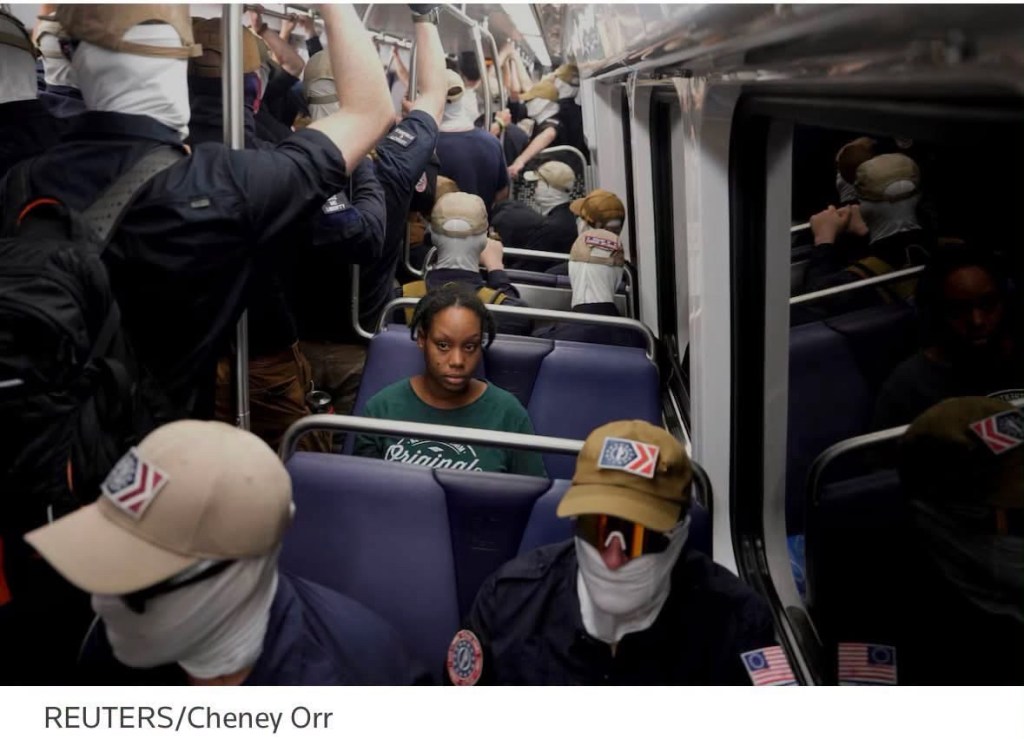
Faces Covered, Hearts Exposed: What This Train Car Teaches Us About Hate And Christian Nationalism

Courage vs Cowards

Today’s a new day! Here are my thoughts on this photo taken on the Metro in Washington, D.C. The following are my thoughts and opinions. If you happen to disagree with me, I encourage you to take it up with God.

Look at this photo. A young woman sits alone on a train, surrounded by dozens of men in matching uniforms, faces covered, patches bearing flags. She meets the camera’s eye. They refuse to be seen.

This image is a parable. And it’s the opposite of the Gospel.

The Gospel unmasks. Hate hides.

Jesus never hid His face. He wept publicly, prayed publicly, died publicly. “I have spoken openly to the world,” He told His accusers. (John 18:20)

Hate loves masks. It loves anonymity, mobs, and intimidation. Why? Because deeds done in darkness don’t survive the light (John 3:20). When an ideology needs to cover faces to deliver its message, it’s already confessed something about that message.

Christian Nationalism too often puts a mask on Jesus. It takes the crucified Savior and dresses Him in the uniform of earthly power. But Christ doesn’t need our flags stitched to His robe. “My kingdom is not of this world” (John 18:36). When we try to make it of this world, we end up looking like this train car: coercive, not compelling.

The Gospel draws near. Hate surrounds.

Notice the posture here. One person, isolated. Many others, standing, looming. That’s not how Jesus moved through crowds. 

He touched lepers when others stepped back. He invited Zacchaeus down from a tree when the crowd boxed him out. He stopped for the woman no one else would look at. The Gospel breaks circles of exclusion. Hate forms them.

Christian Nationalism, at its worst, baptizes “us vs. them.” It defines who belongs and who threatens. But the cross destroyed the dividing wall of hostility (Ephesians 2:14). If our faith needs an enemy to stay strong, it isn’t Christian faith. It’s civil religion with a cross necklace.

The Gospel sees the individual. Hate sees categories.

I don’t know the woman’s name in the photo. You don’t either. But God does. She isn’t a symbol. She’s a person made in His image (Genesis 1:27)

Movements built on hate don’t see people. They see demographics, threats, problems to solve. They make you afraid to sit alone on a train in your own city. 

Jesus’s first question to people was often, “What do you want me to do for you?” (Mark 10:51). He saw individuals. Christian Nationalism tends to see a “nation to save” and turns people into footnotes. When saving “America” matters more than loving the person next to you on the Metro, we’ve lost the plot.

So what do we do when the train car feels like the world?

Uncover our own faces: Confess where contempt has crept into our hearts. It’s easy to hate the masked men too. Jesus doesn’t give us that option. “Love your enemies” (Luke 6:27) includes them.

Sit with the isolated: Who in your life feels like that woman on the train? The Gospel moves us toward them, not away. Proximity kills caricatures.

Refuse the idols of power and fear: The early church changed the Roman Empire without voting, lobbying, or taking up swords. They did it by loving radically and dying well. Our witness still works that way.

Remember what we’re witnessing to: Not a Christian nation. A crucified Christ. “We preach Christ crucified… the power of God and the wisdom of God” (1 Corinthians 1:23-24). 

This photo should grieve us. Not just because of what it says about them, but because of what it reveals about us. Every one of those masked hearts was knit together by God. Every one of them is someone Christ died for. So is she. So are you. So am I.

Hate says, “Cover your face and find your strength in numbers.” 

Jesus says, “Take up your cross and find your life by losing it.”

The train is still running. The choice is still ours. Which kingdom will we board? ~OC

Hope Isles: A New Beginning Chapter Three

The evening air was cool as James sat on the curb across from the old Wilson house.

The young woman clutched the handle of her suitcase.

Neither spoke for several moments.

Finally, James broke the silence.

“My name is James.”

A faint smile crossed her face.

“I know.”

“Then I suppose it’s only fair that I learn your name.”

She looked down at the ground.

“Sarah.”

“It’s nice to meet you, Sarah.”

She nodded.

“You too.”

James could see exhaustion in her eyes.

Not the kind that came from a long day.

The kind that came from carrying heavy burdens for a long time.

“You said Pastor Timothy sent you?”

“Yes.”

“He knows your situation?”

Sarah swallowed hard.

“Some of it.”

James nodded gently.

“You don’t have to tell me anything tonight.”

The tension in her shoulders eased.

For the first time since he’d arrived, she looked slightly relieved.

A few minutes later, James opened the front door.

The old house creaked as they stepped inside.

Sarah stopped in the foyer.

Her eyes widened.

“It’s beautiful.”

“It needs work.”

“It still feels like home.”

The words lingered in the air.

James smiled.

“I hope so.”

He carried her suitcase upstairs.

Stopping at one of the freshly cleaned bedrooms, he opened the door.

A simple bed.

A dresser.

A lamp.

A small Bible on the nightstand.

Nothing fancy.

But it was clean and comfortable.

Sarah stepped into the room slowly.

Almost as if she couldn’t believe it was real.

“You can stay here as long as you need.”

Her eyes immediately filled with tears.

“I don’t know how to thank you.”

“You don’t have to.”

“But you don’t even know me.”

James leaned against the doorway.

“Everybody needs someone to believe in them before they’ve earned it.”

Sarah wiped her eyes.

“Not many people think that way.”

“Someone once did it for me.”

She looked at him curiously.

But James didn’t elaborate.

Not yet.

The next morning, news traveled through Hope Isles at its usual speed.

Which was to say…

Very fast.

By breakfast, half the town knew someone had moved into the Wilson house.

By lunch, everyone knew.

At the Sit Awhile Diner, June was pouring coffee when Joe arrived.

“You heard?” he asked.

June laughed.

“I’ve heard six versions already.”

Joe slid into a booth.

“They say James has a woman living at the house.”

June raised an eyebrow.

“They also said last month that Mayor Jenkins was secretly buying a circus.”

Joe nodded.

“Fair point.”

At that moment, Pastor Timothy entered.

June pointed a coffee pot at him.

“Well?”

“Well what?”

“Settle the rumors.”

Pastor Timothy smiled knowingly.

“Sarah needed help.”

Joe nodded slowly.

“And James helped.”

“Yes.”

June folded her arms.

“That’s all?”

“That’s all.”

The pastor took a sip of coffee.

Then added,

“Sometimes the truth is much less interesting than the gossip.”

Meanwhile, Sarah sat on the Wilson house porch.

For the first time in months, she felt safe.

James was in the front yard planting flowers.

She watched him work.

Eventually she spoke.

“You don’t ask many questions.”

James looked up.

“I ask when people are ready to answer.”

Sarah was quiet.

Then she said,

“I left home.”

James nodded.

“I figured.”

“My dad and I haven’t spoken in almost a year.”

James listened.

“He wanted me to become someone I’m not.”

Sarah stared at the porch railing.

“When I finally left, I thought I’d be okay.”

“What happened?”

“I ran out of money.”

The words came out barely above a whisper.

“And then?”

“I got scared.”

James sat down on the porch steps.

“Thank you for telling me.”

She looked surprised.

“That’s all you’re going to say?”

“For now.”

Sarah laughed softly.

“Most people would’ve given advice by now.”

“I’ve learned advice works better after listening.”

Later that afternoon, James rode his bicycle into town.

As he passed the harbor, he noticed an elderly 

man struggling to carry fishing supplies from his truck.

Without hesitation, James stopped.

“Need a hand?”

The old fisherman grinned.

“Depends.”

“On what?”

“Whether you’re strong enough.”

James laughed.

“Only one way to find out.”

Together they carried the supplies.

When they finished, the fisherman stuck out his hand.

“The name’s Walter.”

James shook it.

“Nice to meet you.”

Walter studied him for a moment.

“So you’re the young fellow everybody keeps talking about.”

“I was hoping that would stop.”

Walter chuckled.

“In Hope Isles?”

“Good point.”

The old fisherman pointed toward town.

“People aren’t talking because you’re new.”

“They’re not?”

“No.”

“Then why?”

Walter smiled.

“Because kindness stands out these days.”

That evening, as the sun sank below the horizon, James sat alone on the porch.

The house behind him felt different now.

Less empty.

More alive.

One room was occupied.

One life was beginning to heal.

As he watched the last rays of sunlight disappear, he heard a voice behind him.

“James?”

It was Sarah.

“Yes?”

She stepped onto the porch.

“I haven’t prayed in a long time.”

James nodded.

“Okay.”

She hesitated.

Then quietly asked,

“Would you pray with me?”

A smile spread across his face.

“Absolutely.”

As the stars began appearing over Hope Isles, the two bowed their heads together on the porch of the old Wilson house.

Neither of them noticed the figure standing across the street, watching from the shadows.

A man.

Older.

Unfamiliar.

And judging by the expression on his face…

He wasn’t there by accident.

To Be Continued…

Rest Is Not Weakness

Today’s a new day! We live in a world that constantly tells us to do more, achieve more, produce more, and stay busy every moment of every day. Culture often promotes the idea that rest is for the weak and that if we slow down, we will somehow fall behind. Yet that mindset is not only unhealthy—it is unbiblical.

God never designed us to run endlessly without pause. From the very beginning, He established the principle of rest. Even after creation, God rested, not because He was tired, but because He was modeling a rhythm that humanity would need.

One of the enemy’s favorite strategies is not always to get us to quit. Sometimes he knows he cannot stop us, so he convinces us to overdo it. He pushes us to take on more than God intended, to carry burdens we were never meant to carry, and to keep running at a pace that eventually leads to exhaustion.

The danger is that by the time we arrive at the destination we have been striving toward, we are too tired, discouraged, or burned out to enjoy the blessings waiting there. We may reach the goal but lack the strength to reap its benefits.

That is why moments of pause are so important. Rest is not wasted time. It is preparation time. It is in those quiet moments that God refreshes our spirits, renews our minds, and restores our strength. Rest allows us to hear His voice more clearly and regain the perspective we often lose in the busyness of life.

The Christian life was never intended to be a sprint. It is a marathon. Scripture repeatedly calls believers to endure, to remain faithful, and to finish the race. Endurance requires strength, and strength requires renewal.

Jesus Himself often withdrew from the crowds to pray and spend time with the Father. If the Son of God prioritized rest and renewal, how much more should we?

So if you have been feeling guilty for slowing down, don’t. Resting is not weakness. It is wisdom. It is recognizing that you are human and that your strength ultimately comes from God.

Take time to pause. Take time to pray. Take time to recharge. The journey ahead is long, and God wants you to finish well.

Remember: this life is a marathon, not a sprint. Rest today so you can continue running tomorrow.

“Come to Me, all who labor and are heavy laden, and I will give you rest.” — Matthew 11:28

I hope this encourages those who have been running hard for a long season and need permission to embrace God’s gift of rest. ~OC

Until Then…

Today’s a new day! 

There are moments in life when God does not call us to speak louder, work harder, or create more. Instead, He calls us into stillness. Into quiet places where our hearts can rest, heal, listen, and be renewed in His presence.

I believe God is leading me into one of those seasons now.

As Laura and I step into this new adventure and begin this new chapter of our lives, I feel the Lord calling me into a season of silence and reflection. Because of that, I will not be sharing any new blog posts, spoken words, or music for a time. This is not a goodbye, but rather a pause — a sacred moment to step away from the noise and spend intentional time in prayer, rest, and seeking the heart of God.

Throughout Scripture, we see God drawing His people away before leading them forward. Moses spent time in the wilderness. Elijah heard God in the gentle whisper. Jesus Himself often withdrew to lonely places to pray. There is something holy about stepping back long enough to hear God clearly again.

Ecclesiastes reminds us that there is “a time to be silent and a time to speak.” Right now, I believe this is my time to be silent.

Silence can feel uncomfortable in a world that constantly demands content, opinions, and activity. Yet sometimes the greatest spiritual growth happens away from the spotlight, in hidden places where only God sees. It is in those quiet moments that He reshapes our hearts, renews our strength, and reminds us who we are apart from what we produce.

I do not know everything God has in store on the other side of this season, but I am excited to discover it. I trust that His plans are good, even when the path ahead is uncertain. This move, this transition, and this pause all feel covered in His peace.

To everyone who has read my writings, listened to my music, encouraged me, prayed for me, or walked alongside me on this journey — thank you. Your kindness and support have meant more than words can express.

As I step away for this season, my prayer for each of you is simple:

May the peace of God guard your hearts and minds.
May His blessings overflow in your homes and families.
May you hear His voice clearly in every season.
And may you never forget that even in silence, God is still moving.

I look forward to seeing what the Lord will do next.

Until then, grace and peace to each of you. ~OC

Haunted By Regret

Today’s a new day! 

Christians are not called to live lives haunted by regret. In Christ, you are not a patched-up version of who you used to be—you are a brand new creation. The old you is gone, not hidden, not waiting to resurface, but fully replaced by the transforming power of God’s grace. Too often, we allow our past mistakes, failures, and pain to whisper lies into our present, trying to convince us that we are still bound to who we were. But the truth stands firm: your past has been erased by the King of kings. What He has forgiven, He has removed. What He has redeemed, He has restored. You are no longer defined by what you’ve done—you are defined by who He says you are.

Walking in that truth means choosing victory over remembrance of defeat. It means refusing to sit in chapters that God has already closed. When you continually revisit your past, you risk giving it power it no longer holds. Instead, God invites you to step forward into the life He has prepared for you—a life filled with purpose, hope, and new beginnings. He has amazing plans for your life, plans that cannot be fulfilled if you remain anchored in yesterday. So stop re-reading those old pages. Let them remain in the past where they belong. Today is a fresh page, and tomorrow is an unwritten chapter. Walk boldly in your new identity, dwell fully in His promises, and start writing a story marked not by regret, but by redemption, victory, and the unshakable faithfulness of God. ~OC

Front Porch Conversations

Today’s a new day! 

When I was growing up, some of the richest moments in life didn’t come from big events or expensive experiences—they came from sitting still and listening. We’d gather around grandparents, older relatives, or even a neighbor leaning back in a worn-out chair, and just soak in their stories. There was something sacred about it. Their voices carried history, wisdom, humor, and lessons you couldn’t learn from a screen. I remember asking questions—not because I had to, but because I wanted to understand where they had been, what they had seen, and how they had made it through life. Those conversations shaped me more than I realized at the time.

These days, that kind of connection feels harder to find. I see young people constantly pulled into their phones, measuring life through likes, shares, and fleeting moments of attention. At the same time, I see many older folks growing frustrated, shaking their heads, and criticizing the very generation they could be pouring into. Somewhere along the way, we stopped meeting in the middle. We traded front porch conversations for comment sections, and real laughter for digital noise. And in doing so, we lost something deeply human.

But it doesn’t have to stay that way. If we truly want a better country, a stronger community, and a more connected world, it starts small—right in our neighborhoods. It looks like putting the phone down, walking outside after dinner, and pulling up a chair in someone’s yard. It looks like asking questions again and taking the time to listen. It looks like older generations choosing to share rather than complain, and younger generations choosing curiosity over distraction. Real life happens in those moments—in the stories, the laughter, the silence between words.

Maybe the answer isn’t complicated at all. Maybe it’s as simple as showing up, being present, and remembering that every person has a story worth hearing. If we can get back to that—back to sharing life instead of scrolling past it—we might just rediscover the kind of connection that can change not only our communities, but the world around us. ~OC

A Love Connection

Today’s a new day! 

Yesterday, Laura and I drove up to North Florida. If you have lived in Florida or parts of the South, you know what time of season it is. Yes, it’s love bug season. Those little insects can be a nuisance, but what if we looked at these annoying little bugs a little closer. Maybe there is a lesson to be learned. 

Every year in parts of the South, love bugs show up in swarms—small, unassuming insects that spend much of their short lives attached to one another. They’re not flashy or impressive, and to most people they’re just a seasonal nuisance. But if you pause long enough to notice, there’s something quietly symbolic about them. Love bugs are almost always seen in pairs, joined together, moving as one. In a simple, created way, they reflect a picture of connection, persistence, and a kind of devoted closeness that’s hard to ignore.

That image can point us to something far deeper—the Gospel of Jesus Christ. The Gospel tells the story of a God who didn’t remain distant, but chose to draw near to us, to bind Himself to humanity through Jesus. Where love bugs cling together for a season, Jesus stepped into our world and held fast to us even through suffering, rejection, and the cross. Scripture reminds us that nothing can separate us from the love of God in Christ—not failure, not pain, not even death. That’s a far stronger bond than anything we see in nature.

There’s also something humbling about love bugs. They don’t try to stand out or make a name for themselves—they simply live out what they were created to do. In the same way, the Gospel calls us to a life not centered on self-promotion, but on abiding in Christ and walking in love. Jesus said that people would recognize His followers by their love, not by their status or accomplishments. When we remain “connected” to Him, like branches to a vine, our lives begin to reflect His grace, patience, and mercy to those around us.

So the next time you see those tiny insects paired together, maybe it’s more than just a seasonal inconvenience. Maybe it’s a small reminder of a greater truth: that we were created for connection—first with God, and then with one another. And through the Gospel, Jesus has made a way for that connection to be restored, secured, and sustained forever. ~OC

Blog at WordPress.com.

Up ↑