Human Trafficking: The Conversation We Cannot Afford To Avoid

Today’s a new day!

For almost twenty years, I have been involved in the fight against human trafficking. It has been one of the most rewarding and heartbreaking journeys of my life. I have seen lives restored, survivors find hope, and communities come together to protect the vulnerable. But I have also seen unimaginable pain, brokenness, and exploitation.

One thing that continues to break my heart is the response I sometimes receive when trying to discuss this horrific crime. More than once, I have heard people say, “I don’t want to hear about that.”

Every time I hear those words, a question immediately comes to mind: What if it were your child? What if it were your grandchild? What if it were your neighbor’s child? Would you still not want to hear about it?

The reality is that human trafficking thrives in darkness and silence. The traffickers count on people looking away. They count on communities being uncomfortable. They count on society deciding that the subject is too disturbing to discuss.

As followers of Jesus, we are called to do the opposite.

Jesus never ignored suffering. He never walked away from broken people because their situation was uncomfortable. He stepped into the pain. He confronted evil. He brought light into dark places. If we are going to follow His example, we cannot close our eyes to the suffering happening around us.

The truth is that every statistic represents a real person. Every number has a name. Every victim has a story. Every life being trafficked is a life created in the image of God. These are sons and daughters, brothers and sisters, friends and neighbors whose dreams are being stolen and whose dignity is being attacked.

Ending human trafficking will require more than awareness campaigns and social media posts. It will require courageous people willing to have difficult conversations. It will require churches willing to educate their congregations. It will require parents willing to talk to their children. It will require communities willing to recognize the warning signs and refuse to remain silent.

Yes, these conversations can be uncomfortable. Yes, they can be heartbreaking. But difficult conversations often lead to life-saving action.

Proverbs 31:8 tells us, “Speak up for those who cannot speak for themselves, for the rights of all who are destitute.”

That is not a suggestion. It is a calling.

We cannot protect what we refuse to discuss. We cannot fight what we refuse to acknowledge. We cannot rescue people if we choose comfort over compassion.

My prayer is that the Church would be known not for avoiding hard topics but for courageously confronting them with truth, love, and action. May we be people who refuse to look away. May we be people who speak up for the vulnerable. May we be people who shine the light of Christ into some of the darkest places in our world.

Because every statistic is a person.

Every person matters to God.

And that is reason enough to have the tough conversations.

This message is difficult, but it’s one that can help bring awareness, protection, and hope to those who need it most. ~OC

If The Twelve Disciples Applied For Church Membership Today

“Think about this for a moment: the twelve disciples of Jesus could not pass a background check to get into most churches today.”

That statement may sound shocking at first, but take a closer look at the men Jesus chose to change the world.

Peter was impulsive and publicly denied Christ three times.

James and John earned the nickname “Sons of Thunder” because of their fiery tempers and desire to call down judgment on people.

Matthew was a tax collector, viewed by many as a traitor and a sinner.

Thomas struggled with doubt.

Simon the Zealot was associated with a radical political movement.

And Judas would eventually betray Jesus.

If these men submitted applications to many modern churches, some would likely be rejected before ever making it through the front door.

Yet these are the very people Jesus chose.

Jesus did not build His ministry around people with perfect resumes. He built it around people whose lives would be transformed by grace.

The Gospel has never been about finding people who have it all together. It has always been about redeeming people who know they don’t.

Too often, we can be tempted to evaluate people based on their past failures, mistakes, addictions, broken relationships, or reputation. We forget that every saint has a past and every sinner has a future when Christ enters the story.

The church was never meant to be a museum displaying perfect people. It was meant to be a hospital where broken people encounter the healing power of Jesus.

Imagine if Jesus had looked at Peter’s denial before calling him. Imagine if He had focused on Thomas’ doubt instead of his potential. Imagine if He had rejected Matthew because of his profession.

The early church would have looked very different.

Thankfully, Jesus sees beyond our failures. He sees who we can become when His grace takes hold of our lives.

This doesn’t mean sin doesn’t matter. It doesn’t mean character is unimportant. Transformation is real, and discipleship matters deeply. But we must remember that transformation is often a process, not an instant event.

The disciples were not finished products when Jesus called them. They were works in progress.

So are we.

So is everyone who will walk through your church doors. 

The next time you encounter someone whose past makes you uncomfortable, remember the men Jesus chose. Remember that the kingdom of God has always been built by redeemed sinners who encountered extraordinary grace.

After all, if God can use fishermen, doubters, hotheads, tax collectors, and former rebels to turn the world upside down, He can certainly use us.

The church should never become a place where people are judged solely by where they have been. It should be a place where people discover who they can become through Jesus Christ.

Grace saw something in the disciples that the world could not see.

May we learn to see people the same way. ~OC

I Cried Out

There are moments in the life of a believer when words fail, when sermons feel too small, and when the only honest response left is tears. Recently, I found myself bowed low on my knees before God, overwhelmed by a grief so deep it felt impossible to fully explain. It was not grief over politics, culture, or the chaos of the world alone. It was grief over the condition of the global Church, especially here in America.

As I prayed, tears streamed down my face. Not tears of hopelessness, but tears of burden. Tears born from the realization that we are living in a critical hour, yet so many believers seem spiritually asleep.

The Church in America has more platforms, more buildings, more resources, and more influence than many generations before us ever dreamed of. Yet somehow, in the middle of abundance, we have often lost our hunger for the presence of God. We have mastered performance while neglecting prayer. We have learned how to build crowds while forgetting how to carry the cross. We have polished the image of Christianity while starving for genuine holiness.

And still, God is calling.

Even now, Heaven is extending mercy.

Even now, the Spirit of God is crying out to awaken His people.

I believe we are standing at a crossroads. One path leads toward comfort, compromise, and spiritual numbness. The other leads toward repentance, purification, surrender, and revival. The frightening reality is that many do not realize the urgency of the moment we are living in. Time is moving quickly. Eternity is drawing near. The hour is late.

The world does not need another watered-down gospel designed to entertain people while leaving them unchanged. The world needs a Church burning with holiness, truth, compassion, humility, and power. It needs believers who are not ashamed of Jesus. It needs disciples willing to pray when nobody is watching, obey when it is unpopular, and love when it costs something.

God is not looking for perfect people. He is looking for surrendered people.

Throughout Scripture, awakening always began the same way: with brokenness. Before revival came repentance. Before restoration came humility. Before God moved publicly, His people first wept privately.

Perhaps that is why the burden feels so heavy right now.

Because deep down, many believers sense that we cannot continue playing games with God. We cannot keep treating the holy things of Heaven casually. We cannot keep building our own kingdoms while neglecting His. We cannot keep blending in with a dying world while claiming to carry the light of Christ.

Jesus did not call us to cultural Christianity. He called us to die to ourselves and follow Him fully.

This is the hour for the Church to return to prayer.

Return to holiness.

Return to the Word of God.

Return to compassion.

Return to reverence.

Return to the secret place.

Return to our first love.

I believe God is shaking everything that can be shaken, not to destroy His people, but to awaken them. Some trust in personalities, platforms, politics, or programs, but none of those things can save us. Our hope has never been in human strength. Our hope is and always will be Jesus Christ.

The answer for America is not found in louder opinions. The answer is repentance and revival. 

The answer is the Church becoming the Church again.

So today, I continue to pray through tears:

“Lord, awaken us again. Purify Your Bride. Burn away every distraction, every idol, every compromise, and every counterfeit thing living inside of us. Teach us to fear You again. Teach us to love what You love. Refocus our hearts on eternity. Let revival begin in us first.”

May we not waste this hour.

May we not sleep through this moment.

May we not stand before God one day realizing we were too distracted by temporary things to pursue what mattered most.

Time is running out.

But the mercy of God is still calling His people home. ~OC

Not A Coincidence

Today’s a new day!

There are moments in life when you look back and wonder how you made it through. The nights that felt endless, the heartbreak that cut deeper than words, the battles you thought would surely take you out—but somehow, you’re still here. It’s easy to chalk it up to luck, coincidence, or sheer willpower. But the truth runs deeper than that. You survived everything that was meant to destroy you, and that’s not a coincidence—that was Jesus. In the middle of the chaos, when you couldn’t see a way forward, He was already making one. When you were too weak to stand, He was carrying you. Even when you didn’t recognize His hand, His presence never left your side.

Jesus doesn’t just show up in the good moments; He proves Himself in the fire. Every trial you walked through and came out of wasn’t just something you endured—it was something He brought you through. The pain didn’t have the final say. The enemy didn’t win. Your story didn’t end there. What was meant to break you became part of the testimony that now defines you. So when doubt tries to creep in and tell you that you’re alone or forgotten, remember your own history. Look at the evidence of grace all over your life. You’re still standing, still breathing, still moving forward—and that’s all the proof you need. Jesus has been faithful before, and He will be faithful again. ~OC

Letter IV: To Those Who Feel Forgotten

Dear America, 

I write to those who feel unseen—those who believe their voices no longer matter, their struggles no longer register, and their hopes have been quietly set aside.

You are not alone in that feeling.

Across this nation, there are countless individuals who sense that the systems meant to serve them have instead overlooked them. 

Economic pressures mount, communities change, and the future feels uncertain. In such moments, frustration can easily turn into resentment, and resentment into division.

But let it be said clearly: your worth is not determined by your circumstances, nor is your voice diminished by your hardship.

The challenge before us is not to compete in suffering, but to recognize it in one another. Only then can we begin to build a society where no one feels abandoned and everyone has a stake in the future.

With steadfast hope,

A Servant of the Dream Yet to Be Fully Realized ~OC

Through Every Season

Today’s a new day! 

A true life of service isn’t measured in titles, applause, or the weight of history books—it’s revealed in quiet consistency, in promises kept when no one would blame you for stepping back.

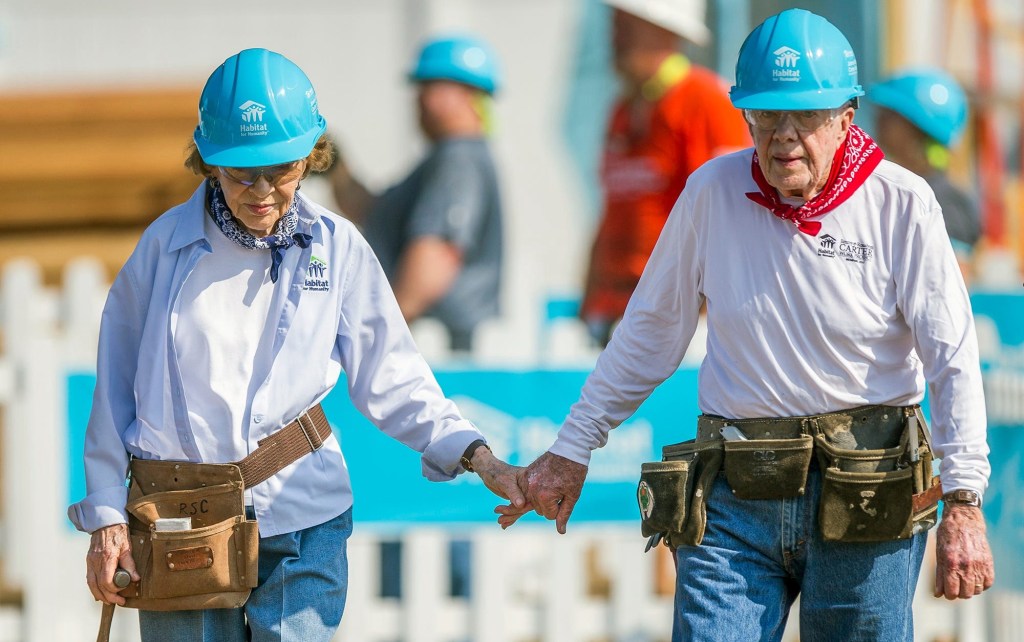
At the state funeral of President Jimmy Carter, his grandson Jason Carter said something simple yet profound: he was the same person no matter who he was with or where he was. Not a version of himself—just himself. Always.

And if you’re looking for proof of that kind of integrity, you don’t have to search long.

In the autumn of 2019, at 95 years old, President Carter fell at his home in Plains, Georgia. He split his forehead, required 14 stitches, and woke the next morning with a blackened eye and a bandage across his brow. For most, that would be reason enough to rest, recover, and cancel whatever came next. 

But Jimmy Carter had made a promise.

So he boarded a plane and flew to Nashville, Tennessee.

That evening, standing before volunteers at the historic Ryman Auditorium, his face bruised and stitched, he didn’t speak about pain or sacrifice. He simply said, “I had a No. 1 priority, and that was to come to Nashville and build houses.”

And the next morning, he did exactly that.

No special treatment. No spotlight. Just jeans, a blue volunteer T-shirt, and a drill in his hand—working shoulder to shoulder with others through Habitat for Humanity to build porches for families who needed homes.

What makes this story even more powerful is that it wasn’t extraordinary for him.

It was normal.

This was the 36th consecutive year he had shown up.

It all began back in 1984, just a few years after leaving the White House. Walking past a build site in New York City, he noticed something most people would overlook—there weren’t enough hands. So he joined in. No announcement. No ceremony. He slept on a church bunk bed while others expected him to make a brief appearance and leave.

Instead, he picked up a hammer and stayed.

He once said, “It’s OK if they want to take my picture holding a hammer, but as long as I’m holding a hammer, it’s going to be hitting a nail.”

And that’s exactly how he lived.

Over the next three and a half decades, President Carter helped build and repair more than 4,300 homes alongside over 100,000 volunteers across 14 countries. He never asked for a different shirt. Never separated himself from the work. Never became a symbol instead of a servant.

He simply showed up.

Again and again.

There’s something deeply challenging about a life like that. Because it strips away excuses. It redefines what greatness looks like. It reminds us that legacy isn’t built in moments of comfort, but in moments of commitment.

A true life of service doesn’t demand recognition—it demands faithfulness.

Not once.
Not occasionally.
But consistently.

Through pain. Through age. Through every season.

And maybe that’s the real takeaway: the world doesn’t just need more leaders—it needs more servants. People who don’t just talk about making a difference, but quietly, faithfully, relentlessly go to work.

Because in the end, the most powerful testimony isn’t what we say.

It’s what we do—day after day, promise after promise, nail after nail. ~OC

Idolatry Is Killing the Church: Putting Jesus Above Politics

There is a quiet crisis unfolding within the Church today—one that is not always visible from the outside, yet deeply felt in the spirit. It is not persecution from the world, nor a lack of resources, nor even declining attendance. It is something far more dangerous: idolatry.

Idolatry is not just the worship of carved images or ancient gods. It is anything that takes the rightful place of Jesus in our hearts. And today, one of the most subtle and pervasive forms of idolatry in the Church is the elevation of politics above Christ.

When political identity becomes more important than spiritual identity, something has gone terribly wrong. When believers are more passionate about defending a party than proclaiming the Gospel, we have misplaced our allegiance. When unity in Christ is sacrificed for political agreement, we are no longer building the Kingdom—we are dividing it.

Jesus never called us to be ambassadors of political systems. He called us to be ambassadors of His Kingdom.

In John 18:36, Jesus said, “My kingdom is not of this world.” Yet many in the Church today live as though it is. We cling to earthly power, believing it will accomplish what only the Holy Spirit can do. We justify attitudes, words, and actions that contradict the very teachings of Christ, all in the name of protecting a political cause.

This is not righteousness. This is idolatry.

The early Church changed the world not through political dominance, but through radical love, humility, and unwavering devotion to Jesus. They didn’t have influence in government—but they had the power of the Gospel. They didn’t seek control—they sought surrender.

Somewhere along the way, we traded the cross for a platform, the Gospel for a talking point, and the mission of Christ for the mission of man.

The result? A watching world that no longer sees Jesus clearly through His Church.

If we are honest, many people outside the Church associate Christianity more with political arguments than with the love of Christ. That should grieve us. Because Jesus said the world would know us by our love—not our affiliations, not our opinions, not our ability to win debates.

The solution is not to abandon civic responsibility or ignore the issues of our day. Christians can and should engage in society. But our engagement must flow from our identity in Christ—not replace it.

We must return to our first love.

Jesus must be above every ideology, every platform, every candidate, and every cause. Our hope is not in governments, but in God. Our mission is not to win elections, but to win hearts. Our calling is not to mirror the world, but to reflect Christ.

It starts with humility. Repenting where we have allowed politics to shape our faith instead of allowing our faith to shape how we engage the world.

It continues with realignment. Re-centering our lives on the teachings of Jesus—His compassion, His truth, His grace, His holiness.

And it is sustained by surrender. Daily choosing to lay down every idol, visible or hidden, and declaring with our lives: Jesus is Lord.

The Church does not need more political power. It needs more spiritual authority. It needs believers who are so rooted in Christ that nothing else can take His place.

Idolatry is killing the Church—but it doesn’t have to.

If we lift Jesus back to where He belongs—above all things—we may just see revival begin again. ~OC

Letter One: From The Tension Of A Nation At Odds With Itself

Hello America,

I write to you from the uneasy space between promise and practice—a place where the ideals we proclaim stand in stark contrast to the realities many experience. Ours is a nation that speaks eloquently of unity while living in deep and widening division.

Our political climate has become less about the pursuit of truth and more about the preservation of power. We no longer simply disagree; we distrust, we dismiss, and too often, we dehumanize. The public square, once a place of vigorous but respectful debate, has been reduced to a battlefield where victory is valued more than virtue.

Yet democracy cannot survive on hostility alone. It requires a shared belief that, despite our differences, we belong to one another. Without that belief, the very foundation of our nation begins to erode.

The urgency of now calls us not to win arguments or elections, but to restore a sense of common purpose.

With steadfast hope,

A Servant of the Dream Yet to Be Fully Realized ~OC

Jackie Robinson Day

Today, is Jackie Robinson Day in Major League Baseball. This day of celebration invites us to pause and remember the courage of Jackie Robinson, who on April 15th 1947, broke Major League Baseball’s color barrier and stepped onto the field with the Brooklyn Dodgers. It was more than a baseball moment—it was a defining chapter in American history. Robinson’s presence challenged deeply rooted segregation and forced a nation to confront its conscience. Nearly eight decades later, we honor his legacy not just with retired numbers and ceremonies across Major League Baseball, but with reflection. The question still lingers: how far have we truly come?

There is no denying that progress has been made. Doors that were once firmly shut have been opened in sports, politics, business, and culture. Opportunities for Black Americans have expanded in ways that would have seemed impossible in 1947. Yet, progress does not mean completion. Racial inequality, though often less visible than in Robinson’s era, still exists in systemic forms—education gaps, economic disparities, and ongoing social tensions. The challenge today is more subtle but no less real. It requires not just acknowledgment, but intentional action and honest conversation.

Jackie Robinson’s story reminds us that change is rarely comfortable. He endured hostility, injustice, and isolation, yet chose perseverance over bitterness. His life asks us a deeper question: are we willing to confront the issues of our own time with the same courage? Celebrating this day should not only be about looking back—it should be about looking inward and forward. Progress is not measured only by how far we’ve come, but by how committed we are to continue the journey. ~OC

All-Time Low

The bar for character and respect among our politicians in America has been lowered so dramatically that it almost feels invisible. What once required integrity, humility, and a genuine sense of service now seems optional—so much so that you don’t even have to jump anymore to clear it. As Christians, this reality should not simply frustrate us; it should challenge us. Scripture reminds us in Philippians 4:8 to dwell on what is true, noble, right, pure, and admirable. When public leadership drifts from these values, it becomes even more important for believers to stand firmly in them, not just in what we expect from others, but in how we live our own lives.

It’s easy to point fingers at leaders and lament the cultural decline, but Jesus calls us to a higher standard. In Matthew 5:13–16, we are described as the salt and light of the world—preserving what is good and illuminating what is right. If the moral bar has fallen in politics, then the responsibility of Christians is not to lower our expectations, but to raise our witness. We are called to model respect, truthfulness, and grace in our conversations, even when others do not. Our hope is not in human leaders, but in God’s unchanging character. And through our daily actions, we can reflect His righteousness in a world that desperately needs it. ~OC

Blog at WordPress.com.

Up ↑