When We Chose Silence

History never arrives wearing a name tag.

It comes in headlines,

executive orders,

courtrooms,

classrooms,

detention centers,

empty dinner tables,

and neighbors who suddenly disappear
from the routines of ordinary life.

It asks no one,
“Do you agree?”

Only,
“Will you notice?”

While some argued over politics,
children wondered if they would see
their parents again after school.

While some celebrated victories,
others quietly packed backpacks,
unsure if tomorrow would still feel
like home.

While many said,
“It isn’t happening to me,”
the circle kept growing,
its shadow stretching farther
than anyone expected.

A journalist lost a voice.

A teacher lost a lesson.

A veteran lost a place to sleep.

A refugee lost hope.

A worker lost dignity.

A family lost certainty.

And every loss whispered
the same question:

Who will stand beside them?

Freedom was never meant
to belong only to those
who look like us,
pray like us,
vote like us,
or were born where we were.

Justice was never intended
to recognize passports
before people.

Compassion was never supposed
to require permission.

One day,
our grandchildren may read
the journals written in 2026.

They may ask why children
wrote about fear instead of dreams.

Why families described hiding
instead of celebrating.

Why so many adults
mistook silence for peace.

I hope they also discover
another story—

Of ordinary people
who refused to let fear
have the final word.

People who crossed
political lines,
cultural lines,
and every invisible line
that divided neighbor from neighbor.

People who understood
that the measure of a nation
is not how loudly it celebrates liberty,
but how faithfully it protects
the vulnerable.

Because history remembers
more than what was done.

It remembers
who looked away,

and who,
at the right moment,

chose to speak. ~OC

How Many Anne Franks Are Hiding Across America?

Today’s a new day!

“In the end, we’ll all become stories.” Those words, often associated with the power of memory, remind us that every life leaves behind a testimony.

Anne Frank’s diary has endured because it captured history through the eyes of a child. She didn’t write knowing the world would one day read her words. She wrote because she was afraid. She wrote because she hoped. She wrote because putting pen to paper was one of the few freedoms she had left.

Her diary asks every generation a difficult question:

What are the children of our day experiencing?

As I look across America in 2026, I can’t help but wonder…

How many children are quietly keeping journals they never intended anyone else to read?

How many are writing about watching a parent disappear after an immigration raid?

How many are describing the fear of hearing a knock at the door?

How many are documenting life spent wondering whether tomorrow will bring another goodbye?

How many families are being torn apart simply because they were born in another country?

These questions are not about comparing one tragedy to another. Every chapter of history has its own unique pain. Instead, they ask us whether we are paying attention to the people living through history right now.

One day, today’s children will grow up.

Some of them may publish memoirs.

Some may never share their stories.

Others may leave behind journals tucked away in closets, attics, or family boxes, discovered years after they’re gone.

What will those pages say about us?

Will they describe neighbors who chose compassion over fear?

Will they remember churches that opened their doors instead of closing their hearts?

Will they write about strangers who offered food, shelter, friendship, and dignity?

Or will they wonder why so many people looked away?

History has an unsettling habit of asking questions that cannot be answered once the moment has passed.

Future generations won’t simply read government policies or political speeches. They’ll read the stories of ordinary people. They’ll hear the voices of children who lived through these days. They’ll ask what the adults around them did when families were hurting.

As followers of Jesus, our calling has never depended on a person’s nationality, language, immigration status, or background.

Jesus consistently moved toward those on the margins.

He welcomed the stranger.

He cared for the vulnerable.

He challenged His followers to love their neighbors—not just the ones who looked like them or believed the same things.

Loving our neighbor doesn’t require us to agree on every political solution. Nations have laws, and citizens can honestly disagree about how those laws should be shaped and enforced.

But compassion should never become a casualty of politics.

A child is still a child.

A frightened family is still a frightened family.

A person created in the image of God is still a person created in the image of God.

Perhaps the question isn’t how many Anne Franks are hiding across America.

Perhaps the better question is this:

Will today’s children remember that someone saw them?

Will they remember someone who chose kindness over indifference?

Will they remember someone who reflected the love of Christ when they needed it most?

Because one day, the diaries of 2026 may be opened.

And when they are, may they tell stories not only of fear, but also of courage.

Not only of uncertainty, but also of hope.

Not only of suffering, but of people who refused to let compassion disappear.

History is being written today.

So is our legacy. ~OC

Who Will You Stand In The Gap For?

Today’s a new day!

There is a question that every follower of Jesus should ask themselves from time to time.

Who am I willing to stand in the gap for?

Is it only the person who looks like you?

The one who thinks like you?

The one who votes like you?

The one who worships like you?

The one who believes exactly as you do?

The one who speaks your language?

The one who was born in the same country as you?

Or are you willing to stand in the gap for anyone God places in your path?

Throughout the Gospels, Jesus continually crossed the boundaries that people had built. He touched those considered unclean. He ate with tax collectors and sinners. He spoke with Samaritans. He healed Roman servants. He welcomed children. He defended the outcast. He loved those society had rejected.

He never asked whether someone had earned His compassion before extending it.

Instead, He saw people made in the image of God.

That same calling has been given to us.

The world is becoming increasingly divided. We are encouraged to place labels on one another before we ever learn each other’s names. Political affiliation, nationality, race, denomination, social status, education, income, and ideology have become walls that separate people.

Yet the Cross tears those walls down.

Jesus did not die only for people who would someday agree with us.

He died for the whole world.

Every refugee.

Every immigrant.

Every prisoner.

Every addict.

Every widow.

Every orphan.

Every veteran.

Every child.

Every elderly neighbor.

Every wealthy executive.

Every person experiencing homelessness.

Every believer.

Every skeptic.

Every person struggling to find hope.

Every person you may never fully understand.

The ground at the foot of the Cross is level.

Our assignment as Christians is not to decide who deserves our love.

Our assignment is to love.

Sometimes standing in the gap means praying for someone who has no one else praying for them.

Sometimes it means buying a meal.

Sometimes it means listening instead of arguing.

Sometimes it means forgiving when forgiveness feels impossible.

Sometimes it means speaking up for someone whose voice has been ignored.

Sometimes it means sitting beside someone everyone else has walked away from.

Sometimes it simply means reminding another person that they are not forgotten.

Standing in the gap isn’t comfortable.

It wasn’t comfortable for Jesus either.

His love carried Him all the way to Calvary.

The Cross reminds us that sacrificial love is rarely convenient, but it is always powerful.

Imagine what our communities would look like if Christians became known less for the people we exclude and more for the people we embrace.

Imagine churches where everyone knew they would be welcomed.

Imagine conversations marked more by grace than by outrage.

Imagine believers who loved so deeply that people caught a glimpse of Jesus before they ever heard a sermon.

That is what it means to be the hands and feet of Christ.

The next time you encounter someone who is different from you, don’t begin by asking whether they deserve your compassion.

Instead, remember this:

Jesus loves them.

Jesus died for them.

Jesus is pursuing them.

And perhaps He is asking you to stand in the gap for them.

May we be people whose love reflects the heart of Christ rather than the divisions of our culture.

May our hands be quick to serve.

May our words be full of grace.

May our prayers extend beyond those who are easy to love.

And may we never forget that someone once stood in the gap for us.

His name is Jesus Christ.

Because He stood in the gap between a holy God and sinful humanity, we have been offered forgiveness, redemption, and eternal life.

Now it is our turn to carry His love into a hurting world.

Who will you stand in the gap for today? ~OC

Healing Prayer

Jesus, Our Amazing Healer

“But He was pierced for our transgressions, He was crushed for our iniquities; the punishment that brought us peace was on Him, and by His wounds we are healed.” — Isaiah 53:5

“Jesus Christ is the same yesterday and today and forever.” — Hebrews 13:8

Dear Heavenly Father,

Today we come before You with grateful hearts, praising You for Your endless love, Your mercy, and the healing found through Your Son, Jesus Christ. You are Jehovah Rapha, the Lord who heals (Exodus 15:26), and nothing is impossible for You (Luke 1:37).

Jesus, throughout the Gospels You touched the blind and they received their sight. You spoke to the lame and they walked. You cleansed those with leprosy, restored the brokenhearted, raised the dead, and brought hope to those who had none. Your compassion never failed, and Your power was always greater than sickness, fear, or despair.

Lord, we stand on Your promises today. Your Word declares, “Praise the Lord, my soul… who forgives all your sins and heals all your diseases” (Psalm 103:2–3). We believe that You still heal hearts, minds, bodies, and souls according to Your perfect will.

Father, bring healing where there is pain. Bring strength where there is weakness. Bring peace where there is anxiety. Restore what illness has stolen. Encourage those who are weary. Comfort those waiting for answers. Let Your Holy Spirit surround every hospital room, every home, every caregiver, and every person crying out to You.

Your Word reminds us in Jeremiah 17:14, “Heal me, Lord, and I will be healed; save me and I will be saved, for You are the one I praise.” We place our trust completely in You.

As James 5:14–15 teaches us, we pray in faith, believing that You hear the prayers of Your people. May every healing become a testimony that points others to Jesus Christ, bringing glory to Your holy name.

Lord, even in seasons when healing comes differently than we expect, help us remember that Your presence never leaves us. Your grace is sufficient, Your strength is made perfect in weakness (2 Corinthians 12:9), and Your plans are always good.

We rejoice because You are our Savior, our Redeemer, our Great Physician, and our Living Hope. Thank You for every miracle You have already done and every miracle still to come.

A Short Closing Prayer

Jesus, thank You for loving us so completely. Fill us with faith, courage, and hope as we trust in Your healing power. Let our lives reflect Your goodness, and may everything we do bring honor and glory to You. We rest in Your unfailing love today and always.

We pray all of these things in the mighty and powerful name of Jesus. Amen.

Relentless Consistency

Today’s a new day!

We live in a world that celebrates the spectacular.

The viral moment.
The overnight success.
The mountaintop experience.

But the Kingdom of God often grows in a much quieter way.

It’s built through relentless consistency.

Faith isn’t measured by how loudly we worship on Sunday morning. It’s measured by whether we still trust Him on Monday afternoon, Wednesday evening, and Friday when life doesn’t make sense.

Anyone can be passionate for a moment.

lAnyone can be inspired after a great sermon,incredible worship service, or a spiritual conference.

But what happens when the music stops?

What happens when the prayers seem unanswered?

What happens when the miracle hasn’t arrived yet?

That’s where relentless consistency begins.

Jesus never called us to be occasional disciples.

He called us to follow Him daily.

Daily taking up our cross.

Daily loving our neighbors.

Daily forgiving those who hurt us.

Daily praying for those who oppose us.

Daily choosing grace over bitterness.

Daily choosing faith over fear.

Daily choosing obedience over convenience.

The Apostle Paul compared the Christian life to a race—not a sprint, but one that requires endurance. The finish line isn’t reached by one incredible burst of speed. It’s reached by putting one faithful foot in front of the other, again and again.

Relentless consistency doesn’t mean perfection.

It means getting back up every time you fall.

It means opening God’s Word even when you don’t feel like it.

It means praying even when the heavens seem silent.

It means serving even when no one notices.

It means loving even when love isn’t returned.

It means worshiping even through tears.

The beautiful thing about consistency is that it builds spiritual roots.

Storms may bend the tree, but deep roots keep it standing.

When our relationship with Christ is built on daily faithfulness instead of emotional highs, we become anchored in His promises rather than our circumstances.

The world may never applaud consistency.

Social media rarely celebrates the person who quietly prays every morning.

Few people notice the believer who faithfully encourages others, serves behind the scenes, gives generously, and walks humbly with God.

But Heaven notices.

Our Father sees every unseen act of obedience.

Every whispered prayer.

Every quiet sacrifice.

Every act of kindness.

Every moment we choose Christ over ourselves.

Galatians reminds us not to grow weary in doing good, for at the proper time we will reap a harvest if we do not give up.

Notice it doesn’t say if we become famous.

It says if we do not give up.

Perhaps revival doesn’t begin with a stadium full of people.

Perhaps it begins with one believer deciding that today they will follow Jesus again.

And tomorrow they will do the same.

And the next day.

And the day after that.

Relentless consistency isn’t glamorous.

It’s holy.

It’s choosing Jesus over and over until the rhythm of faith becomes the rhythm of your life.

So if you’re tired today…

Keep praying.

Keep trusting.

Keep serving.

Keep loving.

Keep forgiving.

Keep showing up.

Keep walking with Jesus.

Because the God who is always faithful is using your relentless consistency to shape you into the image of His Son.

You may not see all that He is doing today.

But one day you’ll look back and realize that every ordinary step of obedience became part of His extraordinary story.

Keep going.

He isn’t finished with you yet. ~OC

Loving Our Immigrant Neighbors

Today’s a new day! 

One of the most beautiful truths found throughout Scripture is this: every person is created in the image of God.

That truth doesn’t stop at a border.

It doesn’t depend on the language someone speaks, the color of their passport, or the country they once called home.

It is a truth that reminds us that every person has immeasurable value because they are loved by their Creator.

Today, my heart is especially drawn toward the immigrant community.

Behind every journey is a story.

Some came seeking opportunity. Others came to reunite with family. Some fled violence, persecution, or desperate circumstances. Many have sacrificed everything they knew in the hope of building a safer, better future for those they love.

While every person’s story is different, one thing remains the same: they deserve to be treated with dignity, kindness, and respect.

As followers of Jesus, our first response should never be fear or indifference. Our first response should be love.

Throughout His earthly ministry, Jesus consistently noticed the people others overlooked. He welcomed those on the margins, showed compassion to those in need, and reminded us that loving our neighbor is not optional—it is central to following Him.

Loving our immigrant neighbors does not require us to agree on every political question or every policy debate. Faithful Christians can hold different views about immigration laws and border security while still agreeing that every human being deserves compassion and should be treated with dignity.

The Gospel calls us to something higher than winning arguments.

It calls us to love.

That love may look like volunteering with a local ministry, helping a family learn English, providing meals, supporting legal aid ministries, mentoring children, offering friendship to someone who feels alone, or simply taking the time to listen to another person’s story.

Sometimes the greatest ministry begins with seeing someone who feels invisible.

The Church has an incredible opportunity to reflect the heart of Christ.

Imagine churches becoming places where newcomers find hope instead of suspicion, friendship instead of isolation, and grace instead of rejection.

Imagine believers praying not only for their own families but also for the families who have traveled difficult roads in search of safety, stability, or a new beginning.

The love of Christ has always crossed every barrier humanity has tried to build.

When we remember that, our hearts begin to change.

Today, let’s pray for immigrant families in our neighborhoods and throughout the world. Pray for their safety, for wisdom for those making difficult decisions, for churches to faithfully serve their communities, and for our leaders as they seek solutions that uphold both justice and compassion.

Then ask the Lord a simple but life-changing question:

“Jesus, how can You use me to love my neighbors today?”

Because prayer is never meant to end with “Amen.”

Prayer changes us.

Prayer opens our eyes.

Prayer moves our hands and feet.

May we become known as people who welcome others with the same grace that Christ has shown us.

One day, people from every tribe, every language, every nation, and every people will stand together before the throne of God, worshiping Jesus with one voice.

Until then, may we live as citizens of His Kingdom—loving generously, serving humbly, praying faithfully, and reflecting the heart of Christ to everyone we meet.

Prayer:

Dear God, we lift up immigrant families around the world and in our own communities. You know every journey, every fear, every hope, and every need. Protect those who are vulnerable, comfort those who are grieving, strengthen families facing uncertainty, and provide opportunities for peace and flourishing. Give wisdom to our leaders as they make difficult decisions, and help Your Church to be a place of compassion, truth, and hope. Teach us to love our neighbors as You have loved us, so that our lives point others to Jesus Christ. In His powerful and holy name we pray, Amen.

If We Don’t Look And Act Like Jesus, Why Would Anyone Want Jesus?

Today’s a new day! ~OC

One of the hardest questions I wrestle with is this:

If I didn’t know Jesus, would the way many Christians act make me want to know Him… or run the other direction?

That’s not a question for “those Christians.” It’s a question for every one of us who claims His name.

Over the years, I’ve had countless conversations with people who don’t believe in Christ. What has surprised me isn’t that they reject Jesus. In fact, many don’t.

Most have no problem with Jesus.

They admire His compassion. They respect His love for the forgotten. They appreciate that He defended the outcast, touched the untouchable, forgave sinners, and confronted religious hypocrisy.

The problem they keep describing isn’t Jesus.

The problem is many of the people who claim to represent Him.

They see Christians who are quicker to judge than to listen.

Quicker to condemn than to comfort.

Quicker to win an argument than to win a soul.

Quicker to defend a political party than to defend the Gospel.

They hear us talk about love while watching us treat people with contempt.

They hear us preach grace while refusing to extend it.

They hear us speak about forgiveness while clinging to bitterness.

Can we really blame a hurting world for being confused?

Jesus said the world would know we belong to Him by our love—not by our outrage, our social media posts, our political victories, or our ability to prove someone wrong.

The early Church turned the world upside down because they looked like Jesus.

They served.

They sacrificed.

They forgave.

They loved people no one else wanted.

They cared for the poor.

They welcomed the stranger.

They laid down their lives rather than demand their rights.

Somewhere along the way, too many of us have become known more for what we’re against than for Who we follow.

That should break our hearts.

The Church was never called to mirror the culture. We were called to reflect Christ.

Being the hands and feet of Jesus isn’t a catchy phrase. It’s our calling.

It means feeding the hungry.

Visiting the lonely.

Welcoming the broken.

Standing with the hurting.

Speaking truth with humility.

Offering grace without compromising the Gospel.

Loving people before expecting them to live like believers.

The world is desperately searching for hope.

Searching for purpose.

Searching for unconditional love.

Searching for life.

They’re looking everywhere because too often they don’t see those things in us.

Imagine what would happen if Christians became impossible to hate—not because we compromised truth, but because we loved so radically that even those who disagreed with us couldn’t deny the presence of Christ.

Imagine if our first instinct was mercy instead of judgment.

Listening instead of assuming.

Serving instead of demanding.

Loving instead of labeling.

That’s exactly what Jesus did.

The Gospel has never changed.

Jesus has never changed.

His love still transforms lives.

His grace still saves.

His cross is still enough.

Maybe the greatest revival our communities need doesn’t begin with the lost finding Jesus.

Maybe it begins with the Church looking like Jesus again.

Lord, let us be known for our love.

Let our words match our witness.

Let our lives point people toward You instead of away from You.

May we never become a stumbling block to those You came to save.

May we truly become Your hands and feet in a world desperate to experience Your hope, Your grace, and Your life.

Amen.

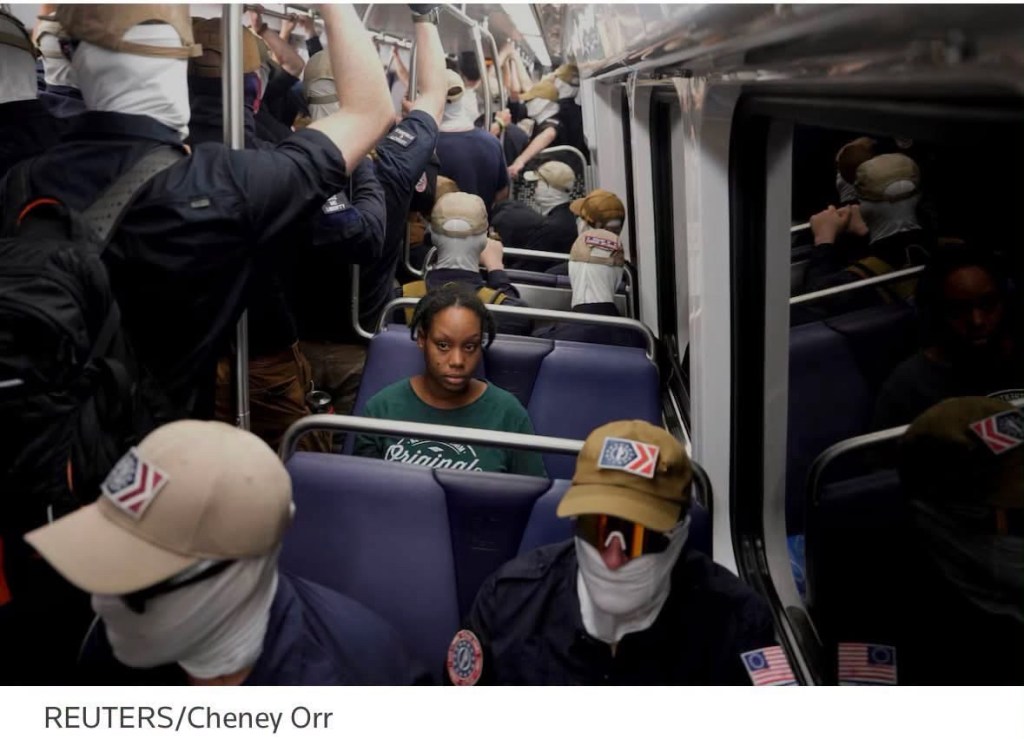
Faces Covered, Hearts Exposed: What This Train Car Teaches Us About Hate And Christian Nationalism

Courage vs Cowards

Today’s a new day! Here are my thoughts on this photo taken on the Metro in Washington, D.C. The following are my thoughts and opinions. If you happen to disagree with me, I encourage you to take it up with God.

Look at this photo. A young woman sits alone on a train, surrounded by dozens of men in matching uniforms, faces covered, patches bearing flags. She meets the camera’s eye. They refuse to be seen.

This image is a parable. And it’s the opposite of the Gospel.

The Gospel unmasks. Hate hides.

Jesus never hid His face. He wept publicly, prayed publicly, died publicly. “I have spoken openly to the world,” He told His accusers. (John 18:20)

Hate loves masks. It loves anonymity, mobs, and intimidation. Why? Because deeds done in darkness don’t survive the light (John 3:20). When an ideology needs to cover faces to deliver its message, it’s already confessed something about that message.

Christian Nationalism too often puts a mask on Jesus. It takes the crucified Savior and dresses Him in the uniform of earthly power. But Christ doesn’t need our flags stitched to His robe. “My kingdom is not of this world” (John 18:36). When we try to make it of this world, we end up looking like this train car: coercive, not compelling.

The Gospel draws near. Hate surrounds.

Notice the posture here. One person, isolated. Many others, standing, looming. That’s not how Jesus moved through crowds. 

He touched lepers when others stepped back. He invited Zacchaeus down from a tree when the crowd boxed him out. He stopped for the woman no one else would look at. The Gospel breaks circles of exclusion. Hate forms them.

Christian Nationalism, at its worst, baptizes “us vs. them.” It defines who belongs and who threatens. But the cross destroyed the dividing wall of hostility (Ephesians 2:14). If our faith needs an enemy to stay strong, it isn’t Christian faith. It’s civil religion with a cross necklace.

The Gospel sees the individual. Hate sees categories.

I don’t know the woman’s name in the photo. You don’t either. But God does. She isn’t a symbol. She’s a person made in His image (Genesis 1:27)

Movements built on hate don’t see people. They see demographics, threats, problems to solve. They make you afraid to sit alone on a train in your own city. 

Jesus’s first question to people was often, “What do you want me to do for you?” (Mark 10:51). He saw individuals. Christian Nationalism tends to see a “nation to save” and turns people into footnotes. When saving “America” matters more than loving the person next to you on the Metro, we’ve lost the plot.

So what do we do when the train car feels like the world?

Uncover our own faces: Confess where contempt has crept into our hearts. It’s easy to hate the masked men too. Jesus doesn’t give us that option. “Love your enemies” (Luke 6:27) includes them.

Sit with the isolated: Who in your life feels like that woman on the train? The Gospel moves us toward them, not away. Proximity kills caricatures.

Refuse the idols of power and fear: The early church changed the Roman Empire without voting, lobbying, or taking up swords. They did it by loving radically and dying well. Our witness still works that way.

Remember what we’re witnessing to: Not a Christian nation. A crucified Christ. “We preach Christ crucified… the power of God and the wisdom of God” (1 Corinthians 1:23-24). 

This photo should grieve us. Not just because of what it says about them, but because of what it reveals about us. Every one of those masked hearts was knit together by God. Every one of them is someone Christ died for. So is she. So are you. So am I.

Hate says, “Cover your face and find your strength in numbers.” 

Jesus says, “Take up your cross and find your life by losing it.”

The train is still running. The choice is still ours. Which kingdom will we board? ~OC

God, What Are You Trying To Teach Me?

Today’s a new day!

Over the past twenty-plus years, I have walked through one of the most difficult journeys of my life. There have been diagnoses I never expected, hospital stays, surgeries, treatments, setbacks, moments of uncertainty, and seasons where I had no idea what tomorrow would bring.

People have often asked me, “Have you ever asked God, ‘Why me?'”

My answer has always been the same.

No.

Not because there is anything wrong with asking that question. In fact, many faithful men and women throughout Scripture poured out their hearts before God. They asked difficult questions. They lamented. They cried. They wrestled with pain. God is not afraid of our honest questions.

But for me personally, “Why me?” was never the question God placed on my heart.

Instead, from the very beginning of this journey, another question kept rising within me:

“God, what are You trying to teach me in this season?”

That simple shift changed everything.

Instead of only looking for an explanation, I began looking for His presence.

Instead of demanding answers, I started seeking wisdom.

Instead of focusing only on what I had lost, I began discovering what God was building inside of me.

Looking back over these twenty-plus years, I realize that some of life’s greatest lessons weren’t learned on the mountaintops. They were learned in hospital rooms, waiting rooms, sleepless nights, rehabilitation sessions, and quiet moments when all I could do was trust Jesus.

So, what has God taught me?

I’m glad you asked.

God has taught me that my identity is not found in my health but in Him.

When your body begins to fail, you quickly discover that your worth isn’t measured by what you can accomplish. My value has never been based on my strength, my productivity, or my abilities. My identity has always been found in being a child of God.

God has taught me that weakness is not failure.

The world celebrates strength, but God’s Kingdom often works through weakness. It is often in our weakest moments that His strength shines the brightest. My limitations have become opportunities for His power to be displayed.

God has taught me patience.

Healing rarely happens on our timetable. Answers don’t always come when we want them. Waiting has never been easy, but waiting with Jesus has shaped my faith in ways instant answers never could.

God has taught me to treasure every single day.

When you’ve stared mortality in the face, ordinary days become extraordinary gifts. A sunrise. A conversation with my bride, Laura. A laugh with a friend. A walk outside. These are no longer ordinary moments—they are reminders of God’s goodness.

God has taught me compassion.

Pain has a way of opening your eyes to the suffering of others. I have learned to notice the people sitting quietly in waiting rooms, the caregivers who are exhausted, the families praying for miracles, and the person who simply needs someone to listen.

God has taught me that prayer changes me.

Sometimes God changes our circumstances.

Sometimes He changes us while we’re in them.

Both are miracles.

God has taught me that hope is never wasted.

Hope isn’t pretending everything is okay.

Hope is believing that Jesus is still faithful when everything around you says otherwise.

Hope is trusting His promises even when you cannot yet see His plan.

Most importantly…

God has taught me that He will never leave me.

Not once.

Not in the emergency room.

Not in the hospital room.

Not during surgery.

Not during the difficult diagnoses.

Not during the darkest nights.

Not during the countless doctor’s appointments.

Not during the moments when I didn’t know what the future would hold.

Jesus has been faithful every single step of the journey.

If you’re reading this while walking through your own difficult season, maybe your question today is, “God, why me?”

If that’s where you are, know this: God welcomes your honesty.

But perhaps, when you’re ready, you might also ask another question:

“Lord, what are You trying to teach me in this season?”

That question doesn’t minimize the pain.

It doesn’t erase the tears.

It doesn’t guarantee immediate answers.

But it does position our hearts to receive what God may be doing beneath the surface.

I’ve learned that while God may not always remove the storm immediately, He is always present within it. Sometimes the greatest miracle isn’t that our circumstances change overnight—it’s that Christ transforms us as we walk through them.

My health journey has been long.

It has been difficult.

It has been painful.

But by God’s grace, it has also been one of the greatest classrooms of my life.

And for every lesson, every trial, every unexpected detour, and every reminder that His grace is sufficient…

I simply say:

“Thank You, Jesus.

Now, Lord…

What would You like to teach me next?” ~OC

Stop Negotiating The Terms Of Your Surrender To God

Today’s a new day!

One of the greatest struggles in the Christian life is not whether we believe in God—it is whether we are willing to surrender everything to Him.

Too often, we approach God with conditions.

“Lord, I’ll follow You… as long as You don’t ask me to give that up.”

“I’ll trust You… if You tell me the whole plan first.”

“I’ll obey… if it doesn’t cost me too much.”

“I’ll forgive… but only if they apologize.”

“I’ll go wherever You lead… except there.”

Without realizing it, we begin negotiating the terms of our surrender.

But surrender isn’t a negotiation.

It’s an act of complete trust.

Jesus never invited His disciples into a contract where both sides could bargain. He invited them into a relationship built on faith, love, and obedience.

When Jesus said, “Follow Me,” He didn’t hand them a detailed itinerary. He didn’t promise comfort, popularity, or an easy life. He simply asked them to trust Him.

And they did.

Real surrender says:

“Jesus, I don’t need to know every step because I know the One who is leading me.”

That kind of faith changes everything.

The truth is, partial surrender is still resistance.

When we hold tightly to our plans, our fears, our pride, our bitterness, or our desire for control, we leave little room for God to do what only He can do.

God isn’t trying to take something good away from us.

He is trying to give us something far greater than we could ever create on our own.

Many of us spend years asking God to bless our plans instead of asking Him to replace them with His.

Yet Scripture reminds us that His ways are higher than ours and His thoughts are higher than ours. What feels like a loss in the moment often becomes the doorway to God’s greatest blessings.

Looking back over my own life, I can honestly say that some of the hardest seasons were also the seasons that taught me the deepest lessons about surrender.

Illness.

Loss.

Disappointment.

Waiting.

None of those chapters were easy.

But every one of them taught me that God’s faithfulness is not dependent upon my understanding.

There were moments when I wanted answers.

God invited me to trust.

There were moments when I wanted control.

God invited me to surrender.

There were moments when I wanted my own timeline.

God reminded me that His timing is always perfect.

I’ve learned that peace doesn’t come from having every question answered.

Peace comes from placing every unanswered question into the hands of Jesus.

The cross itself is the ultimate picture of surrender.

Jesus prayed in the Garden of Gethsemane,

“Not My will, but Yours be done.”

If the Son of God surrendered Himself completely to the Father’s will, how much more should we?

God cannot fully direct a life that refuses to let go of the steering wheel.

He calls us to lay down our dreams, our fears, our expectations, our comfort, our pride, and even our understanding.

Not because He wants less for us.

Because He wants more.

His plans are always better than our plans.

His purpose is greater than our preferences.

His peace is deeper than our control.

So today, stop negotiating the terms of your surrender.

Stop asking God to fit into your agenda.

Instead, ask Him to make your heart fit His.

Lay everything at the foot of the Cross.

Hold nothing back.

Trust Him with the parts of your life that feel uncertain.

Give Him your future.

Give Him your pain.

Give Him your dreams.

Give Him your fears.

Give Him everything.

Because the safest place you will ever be is completely surrendered to Jesus Christ.

True freedom is not found in controlling your life.

It is found in placing your life into the hands of the One who gave His life for you.

Today is a good day to stop negotiating…

…and simply say,

“Lord Jesus, I am Yours.

Have Your way in me.”

Amen. ~OC

Blog at WordPress.com.

Up ↑