Racial Violence. Death. Hanging. Silence.

Tasia Fortune was found hanging.

I do not believe it was suicide.

But if you believe this was a suicide, then you should still demand that every question be answered. If there are circumstances that raise questions about whether her death was truly a suicide, then those questions deserve a real, independent investigation—not dismissal, not silence, and not another case quietly filed away.

Mississippi has a painful history of Black people dying under circumstances that have left families and communities demanding answers. For decades, deaths involving trees, ropes, and hanging have carried the horrifying shadow of America’s history of racial terror.

And now, in 2026, we are still having these conversations.

That should disturb every one of us.

Dear White Community: silence is not neutrality when people are demanding justice.

You don’t have to know every fact to demand that the facts be uncovered.

You don’t have to have all the answers to stand beside a grieving family.

And you don’t have to wait until something happens to someone you love before you decide that every human life deserves the same level of scrutiny, dignity, and protection.

Demand a real investigation.

Demand independent oversight.

Demand federal review when circumstances warrant it.

Demand transparency.

And demand that our laws be strong enough that justice is never dependent upon someone’s race, wealth, power, ZIP code, or political connections.

This isn’t about jumping to conclusions.

It’s about refusing to accept unanswered questions when a human being is dead.

It’s about refusing to let history repeat itself in silence.

It’s about making sure that when a Black person dies under suspicious or disputed circumstances, the response isn’t:

“Move along. Nothing to see here.”

No!

We have something to see.

We have questions to ask.

We have families to hear.

We have institutions to hold accountable.

And we have a moral obligation to insist that  every death deserves the truth.

Because justice delayed is painful.

Justice denied is devastating.

But justice ignored is a choice.

And silence is a choice, too.

Choose to speak.
Choose to ask questions.
Choose to demand the truth. ~OC

Good Trouble for the Church

Today’s a new day!

The late Congressman and civil rights leader John Lewis left us with a simple but powerful challenge: “Get into good trouble, necessary trouble.”Get His words were never an invitation to create chaos. They were a call to courage—to stand for what is right when remaining silent would be easier.

As I look at the state of the American Church today, I can’t help but wonder if we need a little more good trouble.

I love the Church. I believe Jesus established the Church to be the hope of the world, a place where broken people discover healing, where sinners find grace, where the lonely find family, and where the Gospel transforms lives. My concern doesn’t come from a lack of love—it comes because I love the Church too much to stay silent when I see it drifting from its mission.

Too often, it seems many churches and Christian leaders have become more passionate about politics than about the Gospel. We know how to defend a political party, but do we defend the forgotten? We know how to argue over elections, but do we weep over the lost? We rally around candidates, but are we rallying around the Cross?

The Gospel was never meant to be wrapped in a political or American flag.

Jesus didn’t tell His followers to seek political power. He told them to deny themselves, take up their cross, and follow Him. He welcomed the outsider, touched the untouchable, defended the marginalized, and proclaimed good news to the poor. His ministry consistently crossed cultural, social, and political boundaries because His Kingdom was never confined by them.

The Church should be known first for its love—not its voting record.

Perhaps it’s time for some “Good Trouble.”

The kind of good trouble that speaks up when refugees are treated without dignity.

The kind of good trouble that refuses to ignore the hungry, the homeless, the disabled, the widow, the orphan, and the immigrant because Scripture refuses to ignore them.

The kind of good trouble that challenges churches to be known more for compassion than for culture wars.

The kind of good trouble that reminds us our neighbors are not our enemies.

The kind of good trouble that chooses the teachings of Jesus over political talking points.

This isn’t about choosing the political left or the political right. It’s about choosing the narrow road that Jesus called us to walk. The Kingdom of God has never fit neatly inside any political platform.

The early Church changed the world without controlling governments. They changed it because they loved radically, served sacrificially, shared generously, and proclaimed Christ boldly. They cared for plague victims, rescued abandoned children, fed the hungry, and welcomed those society rejected. Their witness wasn’t built on political influence—it was built on Christlike love.

Imagine if today’s Church became known once again for that kind of faith.

Imagine communities where every person—regardless of race, nationality, economic status, disability, or political affiliation—knew they would be welcomed because they bear the image of God.

Imagine churches where serving the poor mattered as much as winning debates.

Imagine Christians who were recognized not by the politicians they defended, but by the Savior they followed.

That’s the kind of good trouble our generation desperately needs.

The Gospel is still good news.

The Cross is still enough.

The Church still has the opportunity to be the light of the world—but only if we remember whose Kingdom we belong to.

May we have the courage to lovingly challenge what needs challenging, to speak truth with grace, and to follow Jesus wherever He leads—even when it costs us comfort, popularity, or influence.

If that causes a little good trouble, perhaps that’s exactly where the Church needs to be. ~OC

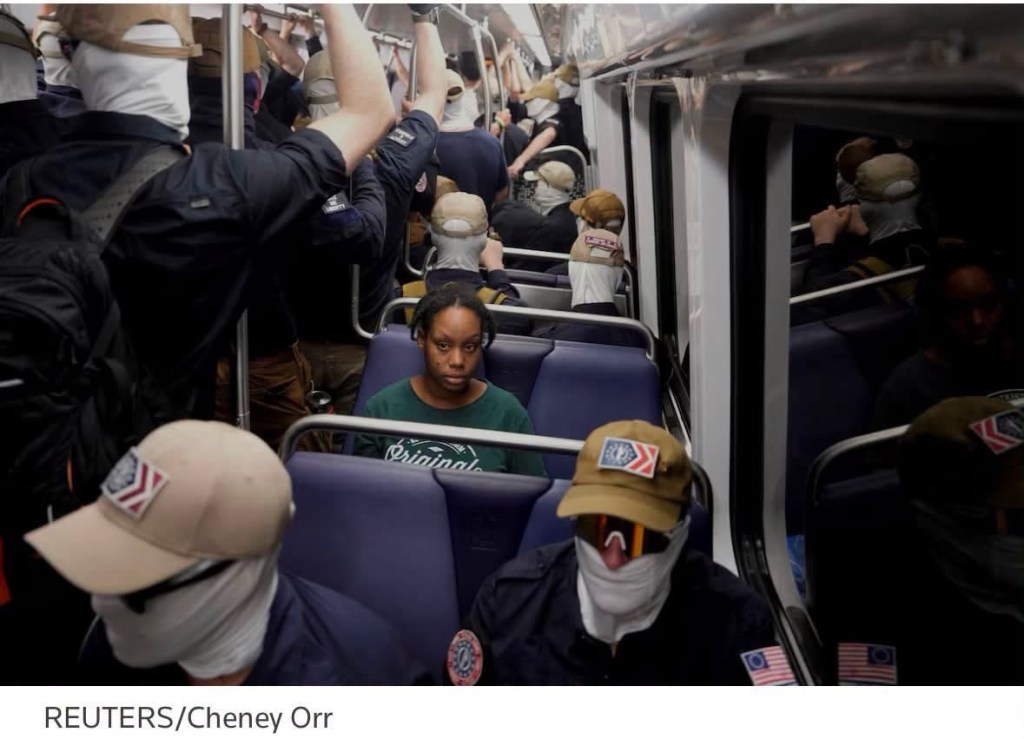
Faces Covered, Hearts Exposed: What This Train Car Teaches Us About Hate And Christian Nationalism

Courage vs Cowards

Today’s a new day! Here are my thoughts on this photo taken on the Metro in Washington, D.C. The following are my thoughts and opinions. If you happen to disagree with me, I encourage you to take it up with God.

Look at this photo. A young woman sits alone on a train, surrounded by dozens of men in matching uniforms, faces covered, patches bearing flags. She meets the camera’s eye. They refuse to be seen.

This image is a parable. And it’s the opposite of the Gospel.

The Gospel unmasks. Hate hides.

Jesus never hid His face. He wept publicly, prayed publicly, died publicly. “I have spoken openly to the world,” He told His accusers. (John 18:20)

Hate loves masks. It loves anonymity, mobs, and intimidation. Why? Because deeds done in darkness don’t survive the light (John 3:20). When an ideology needs to cover faces to deliver its message, it’s already confessed something about that message.

Christian Nationalism too often puts a mask on Jesus. It takes the crucified Savior and dresses Him in the uniform of earthly power. But Christ doesn’t need our flags stitched to His robe. “My kingdom is not of this world” (John 18:36). When we try to make it of this world, we end up looking like this train car: coercive, not compelling.

The Gospel draws near. Hate surrounds.

Notice the posture here. One person, isolated. Many others, standing, looming. That’s not how Jesus moved through crowds. 

He touched lepers when others stepped back. He invited Zacchaeus down from a tree when the crowd boxed him out. He stopped for the woman no one else would look at. The Gospel breaks circles of exclusion. Hate forms them.

Christian Nationalism, at its worst, baptizes “us vs. them.” It defines who belongs and who threatens. But the cross destroyed the dividing wall of hostility (Ephesians 2:14). If our faith needs an enemy to stay strong, it isn’t Christian faith. It’s civil religion with a cross necklace.

The Gospel sees the individual. Hate sees categories.

I don’t know the woman’s name in the photo. You don’t either. But God does. She isn’t a symbol. She’s a person made in His image (Genesis 1:27)

Movements built on hate don’t see people. They see demographics, threats, problems to solve. They make you afraid to sit alone on a train in your own city. 

Jesus’s first question to people was often, “What do you want me to do for you?” (Mark 10:51). He saw individuals. Christian Nationalism tends to see a “nation to save” and turns people into footnotes. When saving “America” matters more than loving the person next to you on the Metro, we’ve lost the plot.

So what do we do when the train car feels like the world?

Uncover our own faces: Confess where contempt has crept into our hearts. It’s easy to hate the masked men too. Jesus doesn’t give us that option. “Love your enemies” (Luke 6:27) includes them.

Sit with the isolated: Who in your life feels like that woman on the train? The Gospel moves us toward them, not away. Proximity kills caricatures.

Refuse the idols of power and fear: The early church changed the Roman Empire without voting, lobbying, or taking up swords. They did it by loving radically and dying well. Our witness still works that way.

Remember what we’re witnessing to: Not a Christian nation. A crucified Christ. “We preach Christ crucified… the power of God and the wisdom of God” (1 Corinthians 1:23-24). 

This photo should grieve us. Not just because of what it says about them, but because of what it reveals about us. Every one of those masked hearts was knit together by God. Every one of them is someone Christ died for. So is she. So are you. So am I.

Hate says, “Cover your face and find your strength in numbers.” 

Jesus says, “Take up your cross and find your life by losing it.”

The train is still running. The choice is still ours. Which kingdom will we board? ~OC

Hope And Class In A Culture Of Insults

Today’s a new day! 

Several people have asked me what I think about the disgusting comments a UFC fighter recently made about former First Lady Michelle Obama. I know his name, but I have chosen not to give him any further publicity by repeating it here.

My thoughts on the matter are actually very simple.

Queens do not step off their thrones to deal with court jesters.

Strong men do not have to put down women to feel powerful.

In a world that seems increasingly driven by outrage, insults, and attention-seeking behavior, I believe we have a choice. We can join the noise, or we can rise above it.

Unfortunately, our culture often rewards the loudest voice, the harshest insult, and the most controversial statement. Social media has created an environment where some people believe that tearing others down is a pathway to relevance. But true character is revealed not by how loudly we criticize others, but by how respectfully we treat them.

Real strength is not found in mocking someone. Real strength is found in showing dignity. It is found in self-control. It is found in refusing to surrender our values simply because someone else abandoned theirs.

Whether we agree with someone’s politics, beliefs, or life choices should never determine whether we treat them with basic human decency. Respect is not a reward reserved only for those who think exactly like we do. Respect is a reflection of our own character.

As followers of Christ, we are called to something higher. Jesus never taught us to build ourselves up by humiliating others. He taught us to love our neighbors, bless those who curse us, and treat others the way we would want to be treated.

The world has enough anger.

The world has enough division.

The world has enough people trying to score points at someone else’s expense.

What our communities need are people who choose grace over outrage, wisdom over mockery, and hope over hate.

And as for me, I will continue to choose hope over bitterness, dignity over insults, and class over chaos.

Life is simply too short to live any other way. ~OC

Letter Two: To A Nation Wrestling With Its Reflection

Dear America, 

There is an undeniable tension in the soul of this country when it comes to matters of race. We have made progress—this cannot be denied—but progress has not erased pain, nor has it resolved the deeper wounds that linger beneath the surface.

Too often, conversations about race are either avoided out of discomfort or inflamed by anger without understanding. In this fragile space, truth becomes a casualty. Some cling to narratives that deny injustice altogether, while others lose hope that reconciliation is even possible.

But we must resist both denial and despair.

The path forward requires honesty—the kind that does not seek to assign guilt, but to illuminate reality. 

It requires empathy—the willingness to step into another’s experience without defensiveness. 

It requires courage—the strength to confront not only the systems around us, but the biases within us.

A nation cannot heal what it refuses to acknowledge.

With steadfast hope,

A Servant of the Dream Yet to Be Fully Realized ~OC

Jackie Robinson Day

Today, is Jackie Robinson Day in Major League Baseball. This day of celebration invites us to pause and remember the courage of Jackie Robinson, who on April 15th 1947, broke Major League Baseball’s color barrier and stepped onto the field with the Brooklyn Dodgers. It was more than a baseball moment—it was a defining chapter in American history. Robinson’s presence challenged deeply rooted segregation and forced a nation to confront its conscience. Nearly eight decades later, we honor his legacy not just with retired numbers and ceremonies across Major League Baseball, but with reflection. The question still lingers: how far have we truly come?

There is no denying that progress has been made. Doors that were once firmly shut have been opened in sports, politics, business, and culture. Opportunities for Black Americans have expanded in ways that would have seemed impossible in 1947. Yet, progress does not mean completion. Racial inequality, though often less visible than in Robinson’s era, still exists in systemic forms—education gaps, economic disparities, and ongoing social tensions. The challenge today is more subtle but no less real. It requires not just acknowledgment, but intentional action and honest conversation.

Jackie Robinson’s story reminds us that change is rarely comfortable. He endured hostility, injustice, and isolation, yet chose perseverance over bitterness. His life asks us a deeper question: are we willing to confront the issues of our own time with the same courage? Celebrating this day should not only be about looking back—it should be about looking inward and forward. Progress is not measured only by how far we’ve come, but by how committed we are to continue the journey. ~OC

Church Silence

Today’s a new day! I am deeply thankful for my church home and for a pastor who is not afraid to speak truth, even when it is uncomfortable. Yesterday, during service, my pastor directly addressed the racist post made by the current President of the United States. In a time when silence has become the easier choice, I am proud of his commitment to confront the issues of our world when they intersect with faith, justice, and the teachings of Jesus. The church was never meant to exist in isolation, sealed off from the pain, hatred, and injustice happening beyond its walls. Faith that refuses to engage the real world is not faith at all—it is avoidance.

That said, I can’t help but ask an important and uncomfortable question: did your pastor address racism yesterday? And if not, why not? It saddens me when churches turn a blind eye to what is happening outside the four walls of their sanctuary. Whether out of fear, concern over attendance, or a desire to remain “neutral,” silence in the face of racism speaks volumes. Personally, I could not belong to a church that is either afraid to address the issues our world faces or willingly chooses to ignore them. Following Jesus means standing for truth, love, and justice—even when it costs us something. Anything less is a distortion of the Gospel. ~OC

A History Lesson

As we celebrate the 4th of July I have seen several post about immigration. I even posted one myself. And of course, several people had to comment about how those coming to America for a better opportunity better do it legally or go back to their home country. That got me to thinking. How many of our ancestors came to America legally over the years? So I did a little research.

When talking about immigration policy many people argue that immigrants coming to the United States should all have to enter the United States legally in order to obtain legal immigration status in the United States.Their argument goes something like this:  We cannot make any changes or exceptions in our immigration laws to allow for any type of “amnesty” because it would be unfair to our ancestors and all those who have immigrated legally to the United States over the years. My response to this argument is that you have to examine what the law actually was when you or your ancestors immigrated to the United States. Unless you are a Native American, everyone currently in the United States is either an immigrant or a descendant of a person who immigrated to the United States. 

When our ancestors came to the United States from countries around the world, they did not enter the United States “legally” or with any sort of visa. That’s because immigration laws were virtually non-existent in 1775, as America was still a colony of the United Kingdom. When most of our ancestors arrived at the different ports, they were likely not asked many questions or subjected to “extreme vetting.” They likely did not have visas or any permission to enter the colony. Under the Naturalization Act of 1790, as long as a person was a “free white person” of “good moral character” (who decided that one?) and they could prove that they had resided in the country for two years and had lived in the same residence for a year, they would be allowed to apply to become citizens. This is how most of our ancestors became citizens. Of course many people were brought to America against their will and in shackles. But today, those white ancestors would be considered “illegal aliens” upon arriving in the United States, and after being illegally in the United States for more than one year, would have to leave the country and come back legally through proper processing, with a waiver of the ten year bar. And only if they had a qualifying relative that petitioned for them.

The immigration laws in the United States have become much more restrictive and complicated, especially since 1996 with the passage of the Illegal Immigration Reform and Immigrant Responsibility Act. Plus the different restrictions that have been enacted since the Reform Act of 1996. So when people argue that their ancestors came to America legally, so current immigrants should as well, I challenge them to examine their family history to determine how their ancestors first came to America. Let us not forget our history. America was built on the backs of immigrants. Most of them here against their will. It’s not politicians who make America great, it’s the immigrants who have traveled far and wide and have endured dangerous situations that make America great. If it were not for so called “amnesty” our ancestors and the rest of our family descendants would not have been “legal” or allowed to become American citizens.

That’s your history for today. I encourage each of you to study history before making blanket statements. ~OC

Jesus Never Said…

Today’s a new day? As I study the Bible here are a few things that stand out to me. ~OC

Jesus never said, Love only your neighbors who agree with you.

Jesus never said, Love only your neighbors that make you feel comfortable.

Jesus never said, Love only your neighbors that worship like you.

Jesus never said, Love only your neighbors that speak like you.

Jesus never said, Love only your neighbors who look like you.

Jesus never said, Love only your neighbors who are citizens of your country.

Jesus never said, Love only your neighbors who vote like you.

Here is what Jesus actually did say:

“‘You must love the Lord your God with all your heart, all your soul, and all your mind.’ This is the first and greatest commandment. A second is equally important: ‘Love your neighbor as yourself.’ The entire law and all the demands of the prophets are based on these two commandments.” ~Matthew 23:37-40

Juneteenth

Today’s a new day! Today is also Juneteenth. I want to share a few thoughts about this day and its significance in American history.

My journey to remembering and celebrating Juneteenth occurred later in life due to a lack of knowledge, as I was educated at a time where most school systems did not adequately teach on African American history and culture. (That’s why we can never return to those days). I believe the history of African Americans and their contributions to American society have often been overlooked or marginalized in traditional education systems. Learning about Juneteenth and understanding its significance can be a powerful awakening to the complexities of American history and the ongoing struggle for racial equality.

‍As I have learned more about Juneteenth, it serves as a reminder of both the injustices of the past and the resilience and perseverance of African Americans in the face of adversity. Juneteenth is not just a celebration of freedom from slavery but also a call to action for social justice and equality for all people. By remembering and celebrating Juneteenth, people of all races can honor the struggles and achievements of African Americans and work together towards a more just society. The journey of learning and growth is valuable not only for personal understanding but also for fostering greater empathy and solidarity across all communities.

‍It is never too late to learn and embrace aspects of history that may have been previously overlooked or omitted. Today, my call to action for you, for me, for communities across America is to be open to truly learning our history. All of our history. This will hopefully allow us to contribute to the broader effort of recognizing and honoring the diverse experiences and contributions of all individuals and communities.

Happy Juneteenth! ~OC

Blog at WordPress.com.

Up ↑