My Hope and Prayer for Each of You

Today’s a new day!

As I continue walking this crazy beautiful journey that God has placed before me, I’ve spent a great deal of time reflecting on what truly matters.

When life is interrupted by doctor’s appointments, hospital stays, difficult diagnoses, and moments that remind you just how fragile life really is, your perspective begins to change.

The things that once seemed so important begin to lose their grip.

The things that truly matter become impossible to ignore.

If I could share one thought with every person I know—my family, my friends, and even those I may never have the privilege of meeting—it is simply this:

Don’t waste your life chasing things that won’t last.

The world constantly tells us to chase more money, more success, more recognition, more followers, more possessions, and more applause.

But none of those things will follow us into eternity.

Only what we do for Christ will last.

So love people well.

Love the people who are not easy to love.

Love the people who disappoint you.

Love the people who think differently than you.

Love the people Jesus loves—which, thankfully, is everyone.

Life is simply too short to withhold kindness.

Forgive quickly.

Bitterness is a prison that only hurts the one carrying it.

Jesus forgave us while we were still sinners. As His followers, may we become known as people who extend the same grace we’ve so freely received.

Encourage often.

You never know what battle someone is fighting behind a smile.

A kind word, a handwritten note, a phone call, a prayer, or simply showing up can become the very thing God uses to carry someone through one more day.

Let’s become people who leave others stronger than we found them.

Walk humbly.

Every blessing we have is a gift from God.

Every talent.

Every opportunity.

Every sunrise.

Every breath.

Humility isn’t thinking less of yourself; it’s thinking of yourself less and making room for Christ to be seen more clearly through your life.

Trust God completely.

Not just when life makes sense.

Trust Him when the diagnosis changes.

Trust Him when the prayers seem unanswered.

Trust Him when the future feels uncertain.

Trust Him because His character never changes, even when our circumstances do.

I’ve learned that God has never once asked me to understand everything.

He has simply asked me to trust Him.

Keep your eyes on Jesus.

The world is loud.

Fear is loud.

Politics are loud.

Social media is loud.

Opinions are loud.

But Jesus still whispers, “Follow Me.”

Don’t allow the noise of this world to drown out the voice of the Good Shepherd.

Fix your eyes on the One who calmed storms, healed broken hearts, welcomed the outcast, carried the cross, defeated death, and still reigns today.

Finally, never forget this beautiful truth:

No matter what you are facing…

His grace is sufficient.

His love never fails.

His mercy is new every morning.

His peace passes understanding.

His presence never leaves you.

His promises are true.

That isn’t wishful thinking.

That is the unchanging character of God.

If my life has taught me anything over these many years, it is this:

Jesus is enough.

Not because life has always been easy.

But because He has always been faithful.

So this is my hope and prayer for each of you.

May you love more deeply than you ever thought possible.

May you forgive as freely as Christ has forgiven you.

May you become an encourager in a world desperate for hope.

May humility become your strength.

May your trust in God grow deeper with every season.

May your eyes remain fixed on Jesus no matter what comes your way.

And when your own earthly journey is complete, may your life tell the story of a Savior who never left your side, never stopped loving you, and never failed to keep His promises.

Until that glorious day, may we continue to walk by faith, love without limits, and shine the light of Christ wherever He leads us.

May our greatest achievement never be measured by what we accumulated, but by how faithfully we loved God and loved people.

And may everything we do point others to Jesus. ~OC

Hope Isles: A New Beginning/Chapter Twenty-Five- A Visitor From The Past

The ferry arrived just after noon.

Most people barely noticed.

Ferries came and went every day.

Tourists arrived.

Supplies were delivered.

Visitors came to experience the charm of Hope Isles.

Nothing unusual.

Except this time, Walter was waiting at the dock.

And he wasn’t waiting for supplies.

He was waiting for her.

The woman with the leather briefcase.

As passengers stepped onto the dock, Walter scanned the crowd.

Then he saw her.

Late fifties.

Silver-streaked hair.

Confident posture.

Kind eyes that seemed to carry years of experience.

When she spotted Walter, she smiled.

“Well, I’ll be.”

Walter laughed softly.

“I wasn’t sure you’d come.”

The woman extended her hand.

“I wasn’t sure you’d call.”

Walter shook it.

“It’s been a long time, Margaret.”

“It has.”

By mid-afternoon, James found himself sitting inside Hope House with Sarah, Walter, and the mysterious visitor.

The briefcase rested on the table.

Margaret looked around the room thoughtfully.

“So this is what Samuel built.”

James leaned forward.

“You knew my grandfather?”

Margaret smiled warmly.

“Very well.”

That immediately got his attention.

Walter folded his arms.

“Margaret worked with Samuel years ago.”

“Worked with him doing what?” James asked.

Margaret chuckled.

“Trying to keep him out of trouble.”

Sarah laughed.

“That sounds like a full-time job.”

“You have no idea.”

For the next hour, Margaret shared stories.

Stories James had never heard.

Stories about a younger Samuel.

A man who wasn’t always wise.

A man who made mistakes.

A man who occasionally charged into situations without thinking.

James found himself smiling.

It sounded surprisingly familiar.

Margaret noticed.

“You’re more like him than you realize.”

James wasn’t entirely sure that was a compliment.

Eventually the conversation became serious.

Margaret carefully opened her briefcase.

Inside were additional documents.

Legal records.

Property agreements.

Letters.

Maps.

Years of history.

She spread them across the table.

“Samuel planned farther ahead than most people knew.”

Walter nodded.

“That’s becoming obvious.”

Margaret pointed to one document.

“He understood that someday Hope Isles would face pressure from outside interests.”

James frowned.

“You mean developers?”

“Exactly.”

The room grew quiet.

Margaret continued.

“Samuel wasn’t against growth.”

“Neither are we,” Sarah said.

Margaret smiled.

“Good. Because neither was he.”

She tapped the documents.

“He simply believed growth should serve people.”

“Not replace them.”

James immediately thought about Hope House.

The café.

The harbor.

The families who called the island home.

The people who had built lives there.

The people who belonged there.

Margaret slid one final document toward James.

“This is why I came.”

James carefully picked it up.

The title immediately caught his eye.

Hope Isles Community Covenant

The paper was old.

Signed decades earlier.

But still legally binding.

His eyes widened as he read.

“What is this?”

Margaret leaned back.

“It’s your grandfather’s vision.”

The covenant outlined principles that would govern the community trust.

Not rules.

Principles.

Commitments.

Promises.

The kind of things that couldn’t be measured in dollars.

Community.

Service.

Stewardship.

Hospitality.

Faith.

Protecting the vulnerable.

Preserving the island’s character.

James felt his throat tighten.

It sounded exactly like Hope Isles.

Not because Samuel had forced it.

Because generations of people had lived it.

That evening, word spread quickly.

Margaret became the newest topic of conversation across town.

June was especially interested.

Naturally.

By sunset, Margaret found herself seated in Sit Awhile Café with a slice of pie she never requested.

June placed another slice in front of her.

Margaret stared.

“I haven’t finished the first one.”

June nodded.

“Nobody ever does.”

Walter laughed into his coffee.

Some things on Hope Isles never changed.

As darkness settled over the harbor, James walked alone to the beach.

The waves rolled gently onto shore.

The storm had passed.

The sea looked peaceful again.

He pulled his grandfather’s letter from his pocket.

For several minutes, he reread portions of it.

Especially the final paragraph.

The words felt different now.

Bigger somehow.

As though he was beginning to understand them.

A voice interrupted his thoughts.

“You look exactly like he did.”

James turned.

Margaret stood nearby.

Hands tucked into her jacket pockets.

“What do you mean?”

She smiled softly.

“The way you’re carrying the weight.”

James looked away.

“I’m not sure I want the responsibility.”

Margaret nodded.

“Neither did Samuel.”

That surprised him.

“Really?”

“Oh yes.”

She looked out toward the ocean.

“The difference is he eventually learned something.”

“What?”

Margaret’s smile deepened.

“God never asks us to carry the future.”

James remained silent.

Waiting.

“He only asks us to be faithful today.”

The words settled deeply.

Almost like something Walter would say.

Or Samuel.

Or perhaps something God had been trying to teach him all along.

The next morning, the island awoke to another surprise.

A large banner had appeared near the harbor.

Professional.

Expensive.

Impossible to ignore.

It announced the public meeting scheduled for the following evening.

The developers had arrived.

And they intended to make their case.

People stopped to read it.

Conversations immediately started.

Tension spread.

Questions multiplied.

Some residents were curious.

Others worried.

A few were already angry.

The storm Walter had sensed was no longer approaching.

It had reached shore.

And before the week was over, Hope Isles would be forced to make a choice.

Not between old and new.

Not between growth and tradition.

But between competing visions of what the island’s future should become.

And hidden among the developers’ plans was one detail nobody had yet discovered.

A detail that connected directly to Daniel.

A connection that would soon place James’s family at the center of the conflict.

To Be Continued..,

Hope Isles: A New Beginning/Chapter Twenty-Four- The Hidden Deed

The storm arrived just after midnight.

Rain lashed against windows.

Wind howled through the harbor.

Waves crashed against the rocks below the lighthouse.

Most of Hope Isles slept through it.

Walter did not.

He remained seated at the old wooden table inside the lighthouse, staring at the faded documents spread before him.

Some pages were nearly fifty years old.

Others were older.

All of them carried the fingerprints of history.

And one document in particular had his full attention.

A deed.

A very unusual deed.

Walter adjusted his glasses and read it again.

Then a third time.

Just to make sure he wasn’t imagining it.

“No wonder you never told anyone,” he whispered.

Outside, thunder rolled across the sea.

Inside, Walter reached for the telephone.

It was late.

Far too late.

But this couldn’t wait.

James was asleep when his phone rang.

He groaned and reached for it.

The clock read 1:17 a.m.

Only a handful of people would ever call him at that hour.

Seeing Walter’s name somehow made him both relieved and nervous.

“Walter?”

“Get dressed.”

James sat upright.

“What happened?”

“Nothing.”

“Then why am I getting dressed at one in the morning?”

Walter paused.

“Because your grandfather left us a surprise.”

Twenty minutes later, James arrived at the lighthouse.

Rain soaked his jacket as he hurried inside.

Walter was waiting.

Coffee already prepared.

Of course.

“You called me out in a storm for coffee?”

Walter slid a folder across the table.

“No.”

James looked down.

The papers appeared old.

Very old.

“What is this?”

Walter leaned back.

“I think it’s your inheritance.”

For the next thirty minutes, Walter explained everything.

The history.

The agreements.

The forgotten legal arrangements.

The promises made decades ago.

By the time he finished, James sat speechless.

“Wait.”

He pointed at the document.

“Read that part again.”

Walter smiled.

“I already have six times.”

James read it himself.

Then again.

Then once more.

Because it seemed impossible.

Hope House wasn’t simply an old building his grandfather had helped create.

The land beneath it had been placed into a special community trust decades earlier.

A trust designed specifically to protect the property from commercial development.

According to the documents, no corporation could purchase it.

No developer could seize it.

No outside investor could control it.

Not unless the community itself agreed.

And there was one more detail.

A surprising one.

The trust named a future steward.

Someone responsible for protecting its mission.

Someone chosen years before they would ever know it.

James stared at the signature.

His grandfather’s handwriting.

Clear as day.

He swallowed hard.

“No.”

Walter nodded.

“Yes.”

“No way.”

Walter smiled.

“I’m afraid so.”

James rubbed his face.

“This says my grandfather named me.”

“He did.”

“Before I was even born?”

“Apparently.”

James looked stunned.

“How is that possible?”

Walter chuckled.

“Samuel never lacked confidence.”

The room grew quiet.

Rain continued hammering the lighthouse windows.

James stared at his grandfather’s signature.

The same man whose mistakes had once created so much pain.

The same man whose faith had eventually rebuilt a family.

The same man whose legacy now seemed larger than anyone realized.

A folded letter slipped from the folder.

James noticed it immediately.

“What is that?”

Walter’s expression softened.

“I haven’t opened it.”

James carefully picked it up.

The envelope was yellowed with age.

Across the front, written in familiar handwriting, were six words:

For My Grandson, James.

His heart skipped.

The room suddenly felt very small.

Walter quietly stood.

“I’ll give you some privacy.”

James nodded.

Unable to speak.

The old man stepped outside.

Leaving James alone with the letter.

For several moments he simply stared at it.

A message written decades ago.

Waiting all these years.

Waiting for him.

Finally, with trembling hands, he opened it.

Inside was a single handwritten page.

The ink had faded.

But the words remained.

James began reading.

And as he read, tears filled his eyes.

Not because the letter contained instructions.

Or legal advice.

Or warnings about the future.

It contained something much simpler.

Something much more important.

Love.

Grace.

Hope.

The very things his grandfather had spent a lifetime learning.

The final paragraph stopped him completely.

“If you are reading this, then God has already carried you farther than I ever could. The buildings may someday disappear. The docks may weather away. Even this island will change. But never forget that Hope House was never meant to be a place. It was meant to be a reminder. A reminder that broken people can heal, divided families can be restored, and God’s grace is always bigger than our failures.”

James lowered the letter.

Silence filled the room.

Only the storm remained.

And somehow, for the first time since the developers had arrived, fear began to loosen its grip.

Because the future of Hope Isles wasn’t resting on a building.

It wasn’t resting on property.

It wasn’t resting on him.

It rested on something far deeper.

Something no storm could wash away.

The next morning, the rain stopped.

The sky slowly cleared.

Sunlight broke through the clouds.

Hope Isles woke to a fresh day.

But news was already spreading.

The developers had officially requested a public meeting with the town.

They would arrive in three days.

Questions would be answered.

Plans would be revealed.

And the future of the island would be debated.

As James stood outside Hope House watching the sunrise, he felt the folded letter in his jacket pocket.

A strange peace settled over him.

The battle ahead would not be easy.

In fact, it was only beginning.

But for the first time, he felt ready.

Not because he had all the answers.

Because he finally understood what was worth protecting.

And what was not.

Far out on the horizon, another ferry appeared.

Slowly making its way toward Hope Isles.

Aboard it sat a woman carrying a leather briefcase.

A woman no one on the island recognized.

A woman whose connection to Samuel’s hidden past would soon change everything.

To Be Continued….

Loving Our Immigrant Neighbors

Today’s a new day! 

One of the most beautiful truths found throughout Scripture is this: every person is created in the image of God.

That truth doesn’t stop at a border.

It doesn’t depend on the language someone speaks, the color of their passport, or the country they once called home.

It is a truth that reminds us that every person has immeasurable value because they are loved by their Creator.

Today, my heart is especially drawn toward the immigrant community.

Behind every journey is a story.

Some came seeking opportunity. Others came to reunite with family. Some fled violence, persecution, or desperate circumstances. Many have sacrificed everything they knew in the hope of building a safer, better future for those they love.

While every person’s story is different, one thing remains the same: they deserve to be treated with dignity, kindness, and respect.

As followers of Jesus, our first response should never be fear or indifference. Our first response should be love.

Throughout His earthly ministry, Jesus consistently noticed the people others overlooked. He welcomed those on the margins, showed compassion to those in need, and reminded us that loving our neighbor is not optional—it is central to following Him.

Loving our immigrant neighbors does not require us to agree on every political question or every policy debate. Faithful Christians can hold different views about immigration laws and border security while still agreeing that every human being deserves compassion and should be treated with dignity.

The Gospel calls us to something higher than winning arguments.

It calls us to love.

That love may look like volunteering with a local ministry, helping a family learn English, providing meals, supporting legal aid ministries, mentoring children, offering friendship to someone who feels alone, or simply taking the time to listen to another person’s story.

Sometimes the greatest ministry begins with seeing someone who feels invisible.

The Church has an incredible opportunity to reflect the heart of Christ.

Imagine churches becoming places where newcomers find hope instead of suspicion, friendship instead of isolation, and grace instead of rejection.

Imagine believers praying not only for their own families but also for the families who have traveled difficult roads in search of safety, stability, or a new beginning.

The love of Christ has always crossed every barrier humanity has tried to build.

When we remember that, our hearts begin to change.

Today, let’s pray for immigrant families in our neighborhoods and throughout the world. Pray for their safety, for wisdom for those making difficult decisions, for churches to faithfully serve their communities, and for our leaders as they seek solutions that uphold both justice and compassion.

Then ask the Lord a simple but life-changing question:

“Jesus, how can You use me to love my neighbors today?”

Because prayer is never meant to end with “Amen.”

Prayer changes us.

Prayer opens our eyes.

Prayer moves our hands and feet.

May we become known as people who welcome others with the same grace that Christ has shown us.

One day, people from every tribe, every language, every nation, and every people will stand together before the throne of God, worshiping Jesus with one voice.

Until then, may we live as citizens of His Kingdom—loving generously, serving humbly, praying faithfully, and reflecting the heart of Christ to everyone we meet.

Prayer:

Dear God, we lift up immigrant families around the world and in our own communities. You know every journey, every fear, every hope, and every need. Protect those who are vulnerable, comfort those who are grieving, strengthen families facing uncertainty, and provide opportunities for peace and flourishing. Give wisdom to our leaders as they make difficult decisions, and help Your Church to be a place of compassion, truth, and hope. Teach us to love our neighbors as You have loved us, so that our lives point others to Jesus Christ. In His powerful and holy name we pray, Amen.

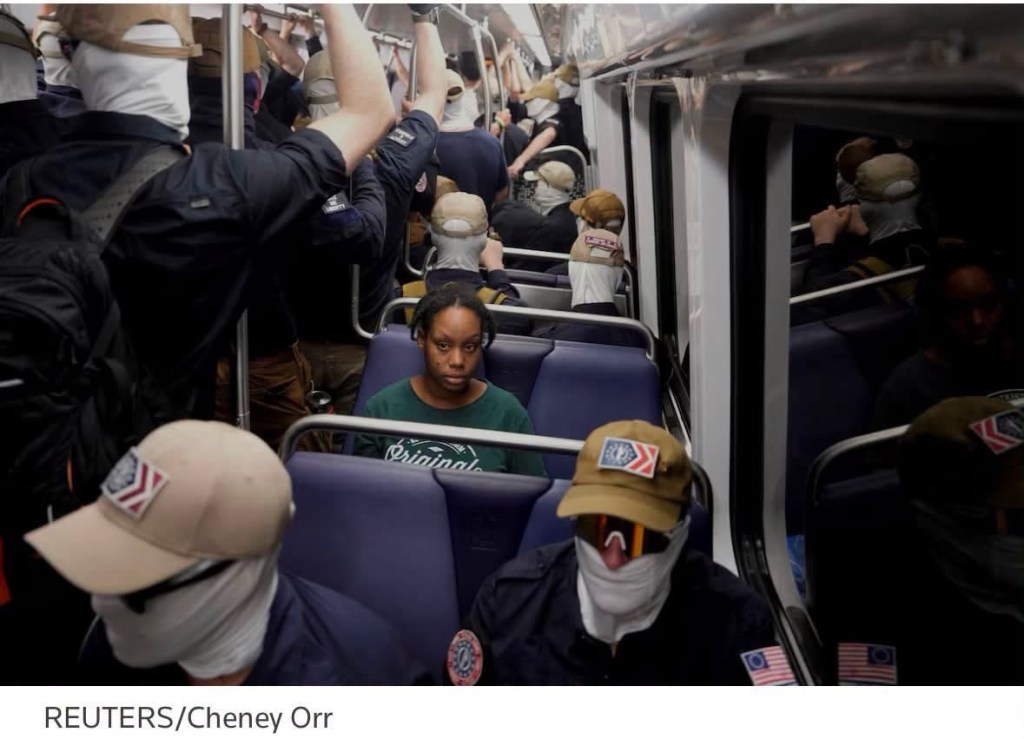
Faces Covered, Hearts Exposed: What This Train Car Teaches Us About Hate And Christian Nationalism

Courage vs Cowards

Today’s a new day! Here are my thoughts on this photo taken on the Metro in Washington, D.C. The following are my thoughts and opinions. If you happen to disagree with me, I encourage you to take it up with God.

Look at this photo. A young woman sits alone on a train, surrounded by dozens of men in matching uniforms, faces covered, patches bearing flags. She meets the camera’s eye. They refuse to be seen.

This image is a parable. And it’s the opposite of the Gospel.

The Gospel unmasks. Hate hides.

Jesus never hid His face. He wept publicly, prayed publicly, died publicly. “I have spoken openly to the world,” He told His accusers. (John 18:20)

Hate loves masks. It loves anonymity, mobs, and intimidation. Why? Because deeds done in darkness don’t survive the light (John 3:20). When an ideology needs to cover faces to deliver its message, it’s already confessed something about that message.

Christian Nationalism too often puts a mask on Jesus. It takes the crucified Savior and dresses Him in the uniform of earthly power. But Christ doesn’t need our flags stitched to His robe. “My kingdom is not of this world” (John 18:36). When we try to make it of this world, we end up looking like this train car: coercive, not compelling.

The Gospel draws near. Hate surrounds.

Notice the posture here. One person, isolated. Many others, standing, looming. That’s not how Jesus moved through crowds. 

He touched lepers when others stepped back. He invited Zacchaeus down from a tree when the crowd boxed him out. He stopped for the woman no one else would look at. The Gospel breaks circles of exclusion. Hate forms them.

Christian Nationalism, at its worst, baptizes “us vs. them.” It defines who belongs and who threatens. But the cross destroyed the dividing wall of hostility (Ephesians 2:14). If our faith needs an enemy to stay strong, it isn’t Christian faith. It’s civil religion with a cross necklace.

The Gospel sees the individual. Hate sees categories.

I don’t know the woman’s name in the photo. You don’t either. But God does. She isn’t a symbol. She’s a person made in His image (Genesis 1:27)

Movements built on hate don’t see people. They see demographics, threats, problems to solve. They make you afraid to sit alone on a train in your own city. 

Jesus’s first question to people was often, “What do you want me to do for you?” (Mark 10:51). He saw individuals. Christian Nationalism tends to see a “nation to save” and turns people into footnotes. When saving “America” matters more than loving the person next to you on the Metro, we’ve lost the plot.

So what do we do when the train car feels like the world?

Uncover our own faces: Confess where contempt has crept into our hearts. It’s easy to hate the masked men too. Jesus doesn’t give us that option. “Love your enemies” (Luke 6:27) includes them.

Sit with the isolated: Who in your life feels like that woman on the train? The Gospel moves us toward them, not away. Proximity kills caricatures.

Refuse the idols of power and fear: The early church changed the Roman Empire without voting, lobbying, or taking up swords. They did it by loving radically and dying well. Our witness still works that way.

Remember what we’re witnessing to: Not a Christian nation. A crucified Christ. “We preach Christ crucified… the power of God and the wisdom of God” (1 Corinthians 1:23-24). 

This photo should grieve us. Not just because of what it says about them, but because of what it reveals about us. Every one of those masked hearts was knit together by God. Every one of them is someone Christ died for. So is she. So are you. So am I.

Hate says, “Cover your face and find your strength in numbers.” 

Jesus says, “Take up your cross and find your life by losing it.”

The train is still running. The choice is still ours. Which kingdom will we board? ~OC

Two Questions Every Christian Should Ask Themselves

Today’s a new day! 

There are two questions that have been on my heart recently, and honestly, they are questions I need to ask myself as much as anyone else.

Question #1: When someone looks at your life, would they want to be like you?

Not because we’re perfect.

Not because we have all the answers.

Not because we’ve never failed.

But when people see our lives, do they see something different? Do they see the peace of Christ in the middle of chaos? Do they see grace when others are harsh? Do they see hope when circumstances seem hopeless? Do they see a faith that remains steady when life gets difficult?

The Apostle Paul boldly wrote, “Follow my example, as I follow the example of Christ” (1 Corinthians 11:1).

That is a challenging statement. Could we honestly say the same?

When people watch how we treat our spouses, our children, our neighbors, the cashier at the grocery store, or even those who disagree with us, are they seeing Jesus reflected in us?

The truth is that our lives may be the only Bible some people ever encounter. Every conversation, every action, every response to adversity is an opportunity to point people toward Christ—or away from Him.

None of us get it right all the time. I certainly don’t. But our goal should be to live in such a way that others are drawn not to us, but to the Savior living within us.

Question #2: Do you have a passion to praise and serve Jesus?

Christianity was never meant to be a once-a-week activity.

It was never meant to be a religious checkbox.

It was never meant to be a routine without relationship.

Jesus gave everything for us. He carried our sins to the Cross, conquered death through His resurrection, and offers us eternal life. How can we not respond with passionate praise and wholehearted service?

Praise isn’t just singing songs on Sunday morning. Praise is thanking God when life is good. Praise is trusting Him when life is hard. Praise is lifting His name when the diagnosis comes, when the bills pile up, when the storm refuses to leave.

Service isn’t just what happens inside church walls. Service happens when we encourage someone who is hurting. It happens when we pray for others. It happens when we meet needs, show compassion, and become the hands and feet of Jesus in a broken world.

The question isn’t whether we attend church.

The question is whether our hearts burn with a love for Jesus.

Do we wake up looking for opportunities to honor Him?

Do we seek ways to serve others in His name?

Do we long to know Him more deeply today than we did yesterday?

A Personal Reflection:

As I ask these questions of my fellow brothers and sisters in Christ, I must also ask them of myself.

When people look at my life, do they see Jesus?

Am I living in a way that inspires others to draw closer to Him?

Do I still have a passion to praise Him through every season?

Do I still have a desire to serve Him with whatever time, talents, and opportunities He has given me?

These aren’t questions meant to bring condemnation. They are questions meant to bring reflection and renewal.

Perhaps today is a good day for all of us to pause and ask God to search our hearts.

May our lives be a testimony of His goodness.

May our words point people toward His truth.

May our actions reflect His love.

And may we never lose our passion to praise and serve the One who gave everything for us.

Lord, let my life be a reflection of You. Help me live in such a way that others see Jesus in me. Rekindle my passion to praise You, serve You, and follow You faithfully every day. Amen. ~OC

When We Care More About Position Than Protection

Today’s a new day!

I know many people may disagree with what I am about to say, and that’s okay. Healthy disagreement is part of life and part of the Church. But I stand firmly by these words.

I care far more about the victims of abuse in our churches than I do about whether a woman teaches a Bible study, preaches a sermon, or stands behind a pulpit in a Southern Baptist Church—or any other church.

For years, countless hours, meetings, conferences, articles, and social media debates have focused on the role of women in ministry. Entire denominations have wrestled with the question. Churches have split over it. Christians have passionately argued both sides.

Yet while some believers are consumed with debates about who is allowed to speak from the platform, children, teenagers, and vulnerable adults have suffered abuse in churches that were supposed to be safe places.

That should break our hearts.

When Jesus walked this earth, He consistently placed people above power, compassion above control, and protection of the vulnerable above religious posturing. He reserved some of His strongest words for religious leaders who burdened others while neglecting justice, mercy, and faithfulness.

I cannot help but wonder what Jesus thinks when churches spend more energy debating who can preach or teach than they spend ensuring children are protected.

I cannot help but wonder what He thinks when victims are ignored, silenced, questioned, or blamed while church leaders focus on preserving reputations and institutions.

The Church should be the safest place on earth for a child.

The safest place for a survivor.

The safest place for the wounded.

The safest place for those seeking healing.

And yet, too often, it has not been.

This is not a statement against theology. 

Theology matters. Scripture matters. Church governance matters. But if our theological discussions become more important than protecting people made in the image of God, something has gone terribly wrong.

If Christians are more concerned about a woman’s role in ministry than they are about children being abused, they have missed something essential in the teachings of Jesus.

If we can passionately argue about positions while remaining silent about victims, we need to examine our priorities.

If we are quicker to defend institutions than to defend the brokenhearted, we need to return to the heart of Christ.

Jesus welcomed children.

Jesus protected the vulnerable.

Jesus stood with the hurting.

Jesus confronted religious leaders who had lost sight of what mattered most.

The Church should do the same.

The world is watching how we respond. More importantly, survivors are watching.

They don’t need another debate.

They need safety.

They need accountability.

They need justice.

They need compassion.

They need to know that the Church values their well-being more than its reputation.

My prayer is that Christians of every denomination would become known not merely for what we believe, but for how fiercely we protect the vulnerable, how seriously we take abuse allegations, how compassionately we care for survivors, and how faithfully we reflect the heart of Jesus.

Because at the end of the day, protecting the vulnerable is not a political issue.

It is not a denominational issue.

It is not a conservative issue or a progressive issue.

It is a Jesus issue. ~OC

Jesus Is Not An Add-On Or An Accessory

In today’s world, accessories are everywhere. We add things to our lives to enhance our appearance, improve our image, or make life a little more comfortable. Accessories are optional. We can put them on when we want and take them off when they become inconvenient.

Unfortunately, many people treat Jesus the same way.

Jesus was never meant to be an add-on to our lives. He is not a spiritual accessory we wear on Sundays and remove on Monday. He is not a good-luck charm we call upon when life gets difficult. He is not a decoration for our social media profiles or a label we attach to ourselves when it is convenient.

Jesus is Lord.

When Jesus called His disciples, He did not invite them to simply add Him to their existing lives. He called them to leave everything and follow Him. Their careers, plans, comforts, and ambitions became secondary to their relationship with Christ. Following Jesus was not a part of their lives—it became their lives.

Too often we try to fit Jesus into our schedules instead of building our schedules around Him. We ask Him to bless our plans rather than surrendering to His plans. We want the benefits of salvation without embracing the daily surrender that discipleship requires.

The Gospel calls us to something deeper.

Jesus doesn’t want a portion of our hearts; He wants all of our hearts. He doesn’t want to be one voice among many voices competing for our attention. He wants to be the foundation upon which every decision, relationship, and dream is built.

When Christ becomes the center of our lives, everything changes. Our priorities change. Our perspective changes. Our purpose changes. We begin to see our jobs as opportunities to serve Him. Our homes become places of ministry. Our struggles become opportunities to trust Him more deeply. Our victories become reasons to give Him glory.

The truth is that Jesus is either Lord of all, or He is not Lord at all.

This does not mean we live perfectly. We all stumble, fail, and fall short. Yet even in our failures, we continue to run toward Him because our relationship with Jesus is not an accessory we can set aside. He is our Savior, our Shepherd, our King, and our source of life.

As believers, may we examine our hearts and ask an important question: Is Jesus simply a part of my life, or is He the center of it?

The world offers countless accessories to make life look better on the outside. Jesus offers something far greater—He transforms us from the inside out.

Jesus is not an add-on.

He is the way, the truth, and the life.

He is everything. ~OC

If The Twelve Disciples Applied For Church Membership Today

“Think about this for a moment: the twelve disciples of Jesus could not pass a background check to get into most churches today.”

That statement may sound shocking at first, but take a closer look at the men Jesus chose to change the world.

Peter was impulsive and publicly denied Christ three times.

James and John earned the nickname “Sons of Thunder” because of their fiery tempers and desire to call down judgment on people.

Matthew was a tax collector, viewed by many as a traitor and a sinner.

Thomas struggled with doubt.

Simon the Zealot was associated with a radical political movement.

And Judas would eventually betray Jesus.

If these men submitted applications to many modern churches, some would likely be rejected before ever making it through the front door.

Yet these are the very people Jesus chose.

Jesus did not build His ministry around people with perfect resumes. He built it around people whose lives would be transformed by grace.

The Gospel has never been about finding people who have it all together. It has always been about redeeming people who know they don’t.

Too often, we can be tempted to evaluate people based on their past failures, mistakes, addictions, broken relationships, or reputation. We forget that every saint has a past and every sinner has a future when Christ enters the story.

The church was never meant to be a museum displaying perfect people. It was meant to be a hospital where broken people encounter the healing power of Jesus.

Imagine if Jesus had looked at Peter’s denial before calling him. Imagine if He had focused on Thomas’ doubt instead of his potential. Imagine if He had rejected Matthew because of his profession.

The early church would have looked very different.

Thankfully, Jesus sees beyond our failures. He sees who we can become when His grace takes hold of our lives.

This doesn’t mean sin doesn’t matter. It doesn’t mean character is unimportant. Transformation is real, and discipleship matters deeply. But we must remember that transformation is often a process, not an instant event.

The disciples were not finished products when Jesus called them. They were works in progress.

So are we.

So is everyone who will walk through your church doors. 

The next time you encounter someone whose past makes you uncomfortable, remember the men Jesus chose. Remember that the kingdom of God has always been built by redeemed sinners who encountered extraordinary grace.

After all, if God can use fishermen, doubters, hotheads, tax collectors, and former rebels to turn the world upside down, He can certainly use us.

The church should never become a place where people are judged solely by where they have been. It should be a place where people discover who they can become through Jesus Christ.

Grace saw something in the disciples that the world could not see.

May we learn to see people the same way. ~OC

Until Then…

Today’s a new day! 

There are moments in life when God does not call us to speak louder, work harder, or create more. Instead, He calls us into stillness. Into quiet places where our hearts can rest, heal, listen, and be renewed in His presence.

I believe God is leading me into one of those seasons now.

As Laura and I step into this new adventure and begin this new chapter of our lives, I feel the Lord calling me into a season of silence and reflection. Because of that, I will not be sharing any new blog posts, spoken words, or music for a time. This is not a goodbye, but rather a pause — a sacred moment to step away from the noise and spend intentional time in prayer, rest, and seeking the heart of God.

Throughout Scripture, we see God drawing His people away before leading them forward. Moses spent time in the wilderness. Elijah heard God in the gentle whisper. Jesus Himself often withdrew to lonely places to pray. There is something holy about stepping back long enough to hear God clearly again.

Ecclesiastes reminds us that there is “a time to be silent and a time to speak.” Right now, I believe this is my time to be silent.

Silence can feel uncomfortable in a world that constantly demands content, opinions, and activity. Yet sometimes the greatest spiritual growth happens away from the spotlight, in hidden places where only God sees. It is in those quiet moments that He reshapes our hearts, renews our strength, and reminds us who we are apart from what we produce.

I do not know everything God has in store on the other side of this season, but I am excited to discover it. I trust that His plans are good, even when the path ahead is uncertain. This move, this transition, and this pause all feel covered in His peace.

To everyone who has read my writings, listened to my music, encouraged me, prayed for me, or walked alongside me on this journey — thank you. Your kindness and support have meant more than words can express.

As I step away for this season, my prayer for each of you is simple:

May the peace of God guard your hearts and minds.
May His blessings overflow in your homes and families.
May you hear His voice clearly in every season.
And may you never forget that even in silence, God is still moving.

I look forward to seeing what the Lord will do next.

Until then, grace and peace to each of you. ~OC

Blog at WordPress.com.

Up ↑