On This National Day Of Prayer

The National Day of Prayer is more than a date on a calendar. It is a reminder that prayer is not supposed to be our last resort, but our first response. Across churches, homes, schools, hospitals, and communities, believers gather to pray for healing, wisdom, revival, peace, and direction. Yet the true challenge for the Christian community is not simply whether we pray publicly for one day, but whether we genuinely believe that God still hears and answers prayer every single day. Scripture reminds us in James 5:16 that “the prayer of a righteous person is powerful and effective.” Those are not symbolic words. They are a promise from God Himself. Too often Christians speak about prayer while secretly battling doubt in their hearts, praying out of routine instead of expectation. But throughout the Bible, prayer moved mountains, opened prison doors, healed the sick, and changed entire nations because people truly believed God was listening.

Living out His Scriptures means more than quoting verses on social media or hearing sermons on Sunday mornings. It means becoming people who actually trust God enough to walk in obedience after we pray. When we pray for peace, we must become peacemakers. When we pray for revival, we must repent and pursue holiness ourselves. When we pray for the hurting, we must be willing to love, serve, and encourage them. Jesus never called believers to have a shallow faith built only on words. He called us to a living faith that produces action, compassion, courage, and transformation. In Mark 11:24, Jesus said, “Whatever you ask for in prayer, believe that you have received it, and it will be yours.” The Christian community must return to praying with faith, expectation, and surrender, knowing that God is still moving even when answers do not arrive on our timeline.

This National Day of Prayer can become more than a tradition if believers truly unite with humble hearts before God. Imagine what could happen if Christians stopped praying powerless prayers filled with fear and started praying bold prayers filled with faith. Imagine churches becoming known not for division or performance, but for love, healing, truth, and the presence of God. The world does not need Christians who only talk about Scripture; it needs believers who live it out daily. Prayer changes things, but prayer also changes us. When we seek God sincerely, He shapes our hearts to reflect His heart. And perhaps that is where revival truly begins — not merely in crowded gatherings, but in believers who genuinely trust God, obey His Word, and live as evidence that Jesus Christ is alive and still working today. ~OC

Mental Health And The Church

Today’s a new day! May is Mental Health Awareness Month, so I wanted to share the following with you. 

The Church has not always handled mental health well. Too many people have been told to “just pray harder,” as if anxiety, depression, trauma, or emotional exhaustion are signs of weak faith. Some believers sit in pews every Sunday carrying panic attacks, grief, addiction, suicidal thoughts, or deep loneliness while smiling through worship songs because they are afraid of being judged. The truth is, loving Jesus does not make someone immune to mental struggles. Even great men and women in Scripture wrestled with despair, fear, exhaustion, and heartbreak. Faith does not erase the reality of being human.

There is nothing unspiritual about having a therapist. Therapy is not replacing God; it can be one of the ways God helps heal people. We do not shame someone for seeing a doctor when they break a bone or have cancer, so we should not shame someone for getting help with their mind and emotions. God can work through pastors, prayer, Scripture, worship, medicine, counselors, and therapists. Sometimes healing comes in a miracle, and sometimes healing comes in honest conversations in an office where someone finally feels safe enough to say, “I’m not okay.”

The Church needs to become a place where people can be real instead of pretending they have it all together. Too often Christians feel pressured to perform holiness while secretly falling apart inside. But Jesus never pushed away the broken. He moved toward them. He sat with hurting people. He listened. He restored dignity. The Church should be the safest place on earth to admit pain, not the most terrifying place to confess it.

If you are struggling mentally or emotionally, needing help does not make you weak, broken, or less Christian. It makes you human. Keep praying. Keep trusting God. But also take the steps toward healing that are in front of you. Talk to someone. Reach out for help. Healing is not always instant, and recovery is not always neat, but God still walks with people through the process. Sometimes faith looks less like pretending to be strong and more like having the courage to finally say, “Lord, I need help.” ~OC

A Warning

Today’s a new day! 

Jesus didn’t spend the majority of His warnings confronting the broken, the wandering, or the openly sinful. Instead, His strongest rebukes were directed at those who stood on the inside—those who knew the language of faith, who held positions of influence, and who used religion as a tool for personal gain. Again and again, He challenged the religious leaders of His day not because they lacked knowledge, but because they had weaponized it. They had turned what was meant to be a pathway to God into a system of control, burdening people with rules while neglecting mercy, justice, and humility. His words were not casual corrections—they were urgent warnings about the danger of a hardened heart hidden behind spiritual appearance.

This truth should cause us to pause and reflect, not on “them,” but on ourselves. It’s easy to point at hypocrisy in others, but Jesus invites us to examine our own motives. Are we using faith to serve, or to be seen? Are we building others up, or subtly controlling, judging, and elevating ourselves? The heart of the Gospel is not about power or performance—it’s about surrender, love, and transformation. Jesus welcomed outsiders with open arms, but He confronted insiders who had lost the heart of God while keeping the form of religion. That same call echoes today: to lay down pride, reject manipulation, and return to a faith that is marked by authenticity, compassion, and a genuine love for God and people. ~OC

A Calling. A Challenge

Today’s a new day!

There are moments when numbers stop being statistics and start becoming something deeply personal. Right now is one of those moments.

Roughly 3 to 3.4 billion people in the world have had little to no access to the Gospel of Jesus Christ. That’s about 40–42% of the global population. Take a moment and really sit with that. Those aren’t just figures on a page. Each number represents a life. A story. A soul created with purpose, longing for truth, searching for hope—whether they realize it yet or not.

It’s easy to feel overwhelmed by a number that large. It can seem distant, like a problem too big for any one person to impact. But the Gospel has never spread because of massive systems alone—it has always moved from person to person, heart to heart, conversation to conversation. And that brings the reality closer than we might be comfortable admitting. 

Because at some point, it becomes personal.

Many of us know the quiet tension that rises when we feel prompted to share our faith. The hesitation. The inner dialogue. What if they reject me? What if they think I’m strange? What if I say the wrong thing? Fear of rejection and ridicule can be powerful enough to silence even the most sincere believer.

But here’s the question we have to wrestle with: what are we more concerned about—the temporary discomfort of being rejected, or the eternal reality that we might be the only person who ever shares Jesus with that individual?

That shifts everything.

We often assume someone else will step in. Someone more equipped, more confident, more eloquent. But what if there is no one else? What if the opportunity in front of you isn’t random, but intentional? A divine appointment placed in your path for a reason?

Jesus didn’t call His followers to comfort—He called them to purpose. He didn’t promise that every conversation would be easy or well received, but He did make it clear that every soul matters. His love is not meant to be contained; it’s meant to be shared. Boldly. Compassionately. Authentically.

And sharing doesn’t always look like standing on a stage or having all the right answers. Sometimes it looks like a simple conversation. A testimony. A moment of kindness that opens the door to something deeper. Sometimes it’s just being willing—available to be used.

The world is searching. Beneath the noise, the distractions, and the brokenness, there is a deep hunger for hope and truth. The message of Jesus is still life-changing. Still healing. Still the answer.

So the question remains: what will we do with the opportunity in front of us?

Will we allow fear to keep us silent, or will we step forward in faith, trusting that God can use even our imperfect words? Will we focus on how we might be perceived, or on the eternal impact a single conversation could have?

Every day presents moments that matter more than we realize. Moments where eternity brushes up against the ordinary. Moments where a simple act of obedience can ripple far beyond what we can see.

Those billions of people aren’t just “out there.” They are closer than we think—in our communities, our workplaces, our daily routines.

And maybe, just maybe, one of them is waiting for someone like you to speak up. ~OC

Front Porch Conversations

Today’s a new day! 

When I was growing up, some of the richest moments in life didn’t come from big events or expensive experiences—they came from sitting still and listening. We’d gather around grandparents, older relatives, or even a neighbor leaning back in a worn-out chair, and just soak in their stories. There was something sacred about it. Their voices carried history, wisdom, humor, and lessons you couldn’t learn from a screen. I remember asking questions—not because I had to, but because I wanted to understand where they had been, what they had seen, and how they had made it through life. Those conversations shaped me more than I realized at the time.

These days, that kind of connection feels harder to find. I see young people constantly pulled into their phones, measuring life through likes, shares, and fleeting moments of attention. At the same time, I see many older folks growing frustrated, shaking their heads, and criticizing the very generation they could be pouring into. Somewhere along the way, we stopped meeting in the middle. We traded front porch conversations for comment sections, and real laughter for digital noise. And in doing so, we lost something deeply human.

But it doesn’t have to stay that way. If we truly want a better country, a stronger community, and a more connected world, it starts small—right in our neighborhoods. It looks like putting the phone down, walking outside after dinner, and pulling up a chair in someone’s yard. It looks like asking questions again and taking the time to listen. It looks like older generations choosing to share rather than complain, and younger generations choosing curiosity over distraction. Real life happens in those moments—in the stories, the laughter, the silence between words.

Maybe the answer isn’t complicated at all. Maybe it’s as simple as showing up, being present, and remembering that every person has a story worth hearing. If we can get back to that—back to sharing life instead of scrolling past it—we might just rediscover the kind of connection that can change not only our communities, but the world around us. ~OC

Not A Coincidence

Today’s a new day!

There are moments in life when you look back and wonder how you made it through. The nights that felt endless, the heartbreak that cut deeper than words, the battles you thought would surely take you out—but somehow, you’re still here. It’s easy to chalk it up to luck, coincidence, or sheer willpower. But the truth runs deeper than that. You survived everything that was meant to destroy you, and that’s not a coincidence—that was Jesus. In the middle of the chaos, when you couldn’t see a way forward, He was already making one. When you were too weak to stand, He was carrying you. Even when you didn’t recognize His hand, His presence never left your side.

Jesus doesn’t just show up in the good moments; He proves Himself in the fire. Every trial you walked through and came out of wasn’t just something you endured—it was something He brought you through. The pain didn’t have the final say. The enemy didn’t win. Your story didn’t end there. What was meant to break you became part of the testimony that now defines you. So when doubt tries to creep in and tell you that you’re alone or forgotten, remember your own history. Look at the evidence of grace all over your life. You’re still standing, still breathing, still moving forward—and that’s all the proof you need. Jesus has been faithful before, and He will be faithful again. ~OC

We Need More Mr. Rogers’

Today’s a new day!

There was something quietly powerful about Fred Rogers. He didn’t need to raise his voice to be heard, didn’t rely on insults to make a point, and never tried to win by tearing someone else down. In a world that often feels louder, harsher, and quicker to judge, his gentle way of speaking truth with kindness stands out more than ever. The neighborhoods he built on Mister Rogers’ Neighborhood weren’t just for children—they were a blueprint for how we might treat one another as adults. He reminded us that every person has value, that feelings are worth acknowledging, and that kindness is not weakness—it’s strength under control.

Contrast that with the culture we often see today, where bullying has been repackaged as confidence and cruelty gets disguised as honesty. Whether it shows up in schools, online spaces, or even public leadership, the tone can feel more like a battleground than a community. But the truth is, tearing people down has never built anything lasting. The world doesn’t need more voices shouting over each other—it needs more people willing to listen, to care, and to choose empathy over ego. Imagine what would happen if we measured success not by how many people we outshine, but by how many we lift up.

Maybe the call is simpler than we think. Be a little more patient. Speak a little more gently. Choose to understand before reacting. Those aren’t outdated ideals—they’re desperately needed ones. The legacy of Fred Rogers isn’t just something to admire from a distance; it’s something to live out in small, daily decisions. Because in the end, the world changes not through louder arguments, but through quieter acts of love. ~OC

A King, A Calling, and A Cross: What Black Panther Teaches Us About the Christian Life

Today’s a new day!

The movie Black Panther isn’t just a superhero story—it’s a powerful exploration of identity, responsibility, legacy, and redemption. Beneath the action and spectacle lies a message that echoes deeply with the Christian life: who we are, what we inherit, and how we choose to live in light of truth.

1. Identity: Knowing Who You Are

T’Challa doesn’t just become king—he must understand what it means to be king. 

Throughout the film, he wrestles with the legacy of his father and the expectations placed upon him. In a similar way, Christians are not just given a title—we are given a new identity in Christ.

Scripture reminds us that we are children of God, heirs to His promises. But like T’Challa, we often wrestle with that identity. Are we defined by our past, our culture, our failures—or by what God says about us?

The Christian life begins when we stop asking, “Who does the world say I am?” and start embracing, “Who does God say I am?”

2. Legacy: Breaking What Needs to Be Broken

One of the most striking themes in Black Panther is confronting the past. T’Challa discovers that not everything handed down to him is righteous or just. His father made decisions rooted in fear and secrecy, and those choices had consequences.

As believers, we also inherit things—family patterns, cultural influences, even spiritual habits. Not all of them align with God’s truth. Following Jesus sometimes means breaking cycles, stepping out of what’s familiar, and choosing obedience over tradition.

Faith isn’t about preserving everything from the past—it’s about redeeming what honors God and letting go of what doesn’t.

3. Compassion Over Isolation

Wakanda’s greatest strength was also its greatest flaw: isolation. They had the resources to help the world but chose to remain hidden. By the end of the film, T’Challa realizes that true leadership means reaching outward, not retreating inward.

This mirrors the call of the Gospel. Jesus didn’t come to build walls—He came to tear them down. The Christian life is not meant to be lived in isolation, hoarding blessings. We are called to go, to serve, to love, and to bring light into dark places.

Faith that stays hidden isn’t faith fully lived.

4. Redemption: Even Broken Stories Matter

Erik Killmonger is one of the most complex characters in the film. His pain is real, his anger is understandable, but his path leads to destruction. He represents what happens when wounds go unhealed and justice is pursued without mercy.

Christianity doesn’t ignore pain—it transforms it. The Gospel tells us that no story is too broken, no past too far gone. Where the world sees enemies, Jesus sees people worth saving.

T’Challa’s final moments with Killmonger reflect a glimpse of grace—a recognition of pain, even in opposition. As believers, we are called to see people not just for what they’ve done, but for what God can do in them.

5. The True King

At its core, Black Panther is about kingship—what it means to lead, to serve, and to sacrifice. T’Challa grows into a king who listens, who humbles himself, and who ultimately chooses what is right over what is easy.

But as Christians, we follow a greater King—Jesus Christ. Unlike earthly rulers, He didn’t take a throne by force; He carried a cross. He didn’t protect His kingdom through power, but through sacrifice and love.

And He calls us to live the same way.

Final Thoughts

Black Panther reminds us that strength isn’t just about power—it’s about character. It’s about choosing truth over tradition, compassion over comfort, and purpose over pride.

The Christian life is a journey of becoming who God created us to be, confronting what needs to change, and stepping boldly into a calling bigger than ourselves.

Like T’Challa, we are given a kingdom to influence—not with vibranium, but with faith, hope, and love.

And the question remains:

Will we hide what God has given us…
or will we use it to change the world? ~OC

Letter IV: To Those Who Feel Forgotten

Dear America, 

I write to those who feel unseen—those who believe their voices no longer matter, their struggles no longer register, and their hopes have been quietly set aside.

You are not alone in that feeling.

Across this nation, there are countless individuals who sense that the systems meant to serve them have instead overlooked them. 

Economic pressures mount, communities change, and the future feels uncertain. In such moments, frustration can easily turn into resentment, and resentment into division.

But let it be said clearly: your worth is not determined by your circumstances, nor is your voice diminished by your hardship.

The challenge before us is not to compete in suffering, but to recognize it in one another. Only then can we begin to build a society where no one feels abandoned and everyone has a stake in the future.

With steadfast hope,

A Servant of the Dream Yet to Be Fully Realized ~OC

Through Every Season

Today’s a new day! 

A true life of service isn’t measured in titles, applause, or the weight of history books—it’s revealed in quiet consistency, in promises kept when no one would blame you for stepping back.

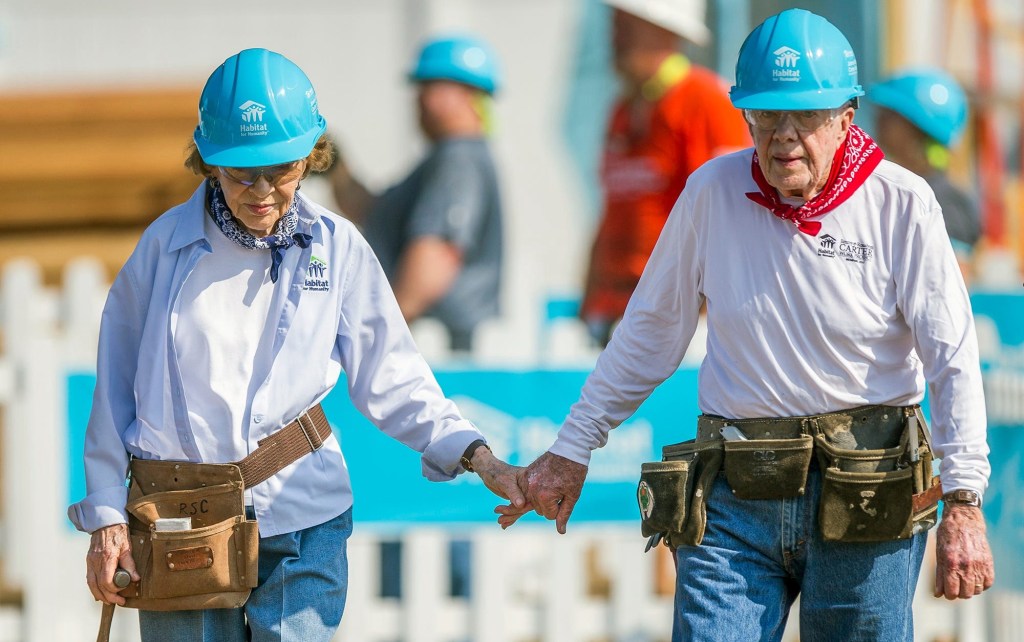
At the state funeral of President Jimmy Carter, his grandson Jason Carter said something simple yet profound: he was the same person no matter who he was with or where he was. Not a version of himself—just himself. Always.

And if you’re looking for proof of that kind of integrity, you don’t have to search long.

In the autumn of 2019, at 95 years old, President Carter fell at his home in Plains, Georgia. He split his forehead, required 14 stitches, and woke the next morning with a blackened eye and a bandage across his brow. For most, that would be reason enough to rest, recover, and cancel whatever came next. 

But Jimmy Carter had made a promise.

So he boarded a plane and flew to Nashville, Tennessee.

That evening, standing before volunteers at the historic Ryman Auditorium, his face bruised and stitched, he didn’t speak about pain or sacrifice. He simply said, “I had a No. 1 priority, and that was to come to Nashville and build houses.”

And the next morning, he did exactly that.

No special treatment. No spotlight. Just jeans, a blue volunteer T-shirt, and a drill in his hand—working shoulder to shoulder with others through Habitat for Humanity to build porches for families who needed homes.

What makes this story even more powerful is that it wasn’t extraordinary for him.

It was normal.

This was the 36th consecutive year he had shown up.

It all began back in 1984, just a few years after leaving the White House. Walking past a build site in New York City, he noticed something most people would overlook—there weren’t enough hands. So he joined in. No announcement. No ceremony. He slept on a church bunk bed while others expected him to make a brief appearance and leave.

Instead, he picked up a hammer and stayed.

He once said, “It’s OK if they want to take my picture holding a hammer, but as long as I’m holding a hammer, it’s going to be hitting a nail.”

And that’s exactly how he lived.

Over the next three and a half decades, President Carter helped build and repair more than 4,300 homes alongside over 100,000 volunteers across 14 countries. He never asked for a different shirt. Never separated himself from the work. Never became a symbol instead of a servant.

He simply showed up.

Again and again.

There’s something deeply challenging about a life like that. Because it strips away excuses. It redefines what greatness looks like. It reminds us that legacy isn’t built in moments of comfort, but in moments of commitment.

A true life of service doesn’t demand recognition—it demands faithfulness.

Not once.
Not occasionally.
But consistently.

Through pain. Through age. Through every season.

And maybe that’s the real takeaway: the world doesn’t just need more leaders—it needs more servants. People who don’t just talk about making a difference, but quietly, faithfully, relentlessly go to work.

Because in the end, the most powerful testimony isn’t what we say.

It’s what we do—day after day, promise after promise, nail after nail. ~OC

Blog at WordPress.com.

Up ↑