Good Trouble for the Church

Today’s a new day!

The late Congressman and civil rights leader John Lewis left us with a simple but powerful challenge: “Get into good trouble, necessary trouble.”Get His words were never an invitation to create chaos. They were a call to courage—to stand for what is right when remaining silent would be easier.

As I look at the state of the American Church today, I can’t help but wonder if we need a little more good trouble.

I love the Church. I believe Jesus established the Church to be the hope of the world, a place where broken people discover healing, where sinners find grace, where the lonely find family, and where the Gospel transforms lives. My concern doesn’t come from a lack of love—it comes because I love the Church too much to stay silent when I see it drifting from its mission.

Too often, it seems many churches and Christian leaders have become more passionate about politics than about the Gospel. We know how to defend a political party, but do we defend the forgotten? We know how to argue over elections, but do we weep over the lost? We rally around candidates, but are we rallying around the Cross?

The Gospel was never meant to be wrapped in a political or American flag.

Jesus didn’t tell His followers to seek political power. He told them to deny themselves, take up their cross, and follow Him. He welcomed the outsider, touched the untouchable, defended the marginalized, and proclaimed good news to the poor. His ministry consistently crossed cultural, social, and political boundaries because His Kingdom was never confined by them.

The Church should be known first for its love—not its voting record.

Perhaps it’s time for some “Good Trouble.”

The kind of good trouble that speaks up when refugees are treated without dignity.

The kind of good trouble that refuses to ignore the hungry, the homeless, the disabled, the widow, the orphan, and the immigrant because Scripture refuses to ignore them.

The kind of good trouble that challenges churches to be known more for compassion than for culture wars.

The kind of good trouble that reminds us our neighbors are not our enemies.

The kind of good trouble that chooses the teachings of Jesus over political talking points.

This isn’t about choosing the political left or the political right. It’s about choosing the narrow road that Jesus called us to walk. The Kingdom of God has never fit neatly inside any political platform.

The early Church changed the world without controlling governments. They changed it because they loved radically, served sacrificially, shared generously, and proclaimed Christ boldly. They cared for plague victims, rescued abandoned children, fed the hungry, and welcomed those society rejected. Their witness wasn’t built on political influence—it was built on Christlike love.

Imagine if today’s Church became known once again for that kind of faith.

Imagine communities where every person—regardless of race, nationality, economic status, disability, or political affiliation—knew they would be welcomed because they bear the image of God.

Imagine churches where serving the poor mattered as much as winning debates.

Imagine Christians who were recognized not by the politicians they defended, but by the Savior they followed.

That’s the kind of good trouble our generation desperately needs.

The Gospel is still good news.

The Cross is still enough.

The Church still has the opportunity to be the light of the world—but only if we remember whose Kingdom we belong to.

May we have the courage to lovingly challenge what needs challenging, to speak truth with grace, and to follow Jesus wherever He leads—even when it costs us comfort, popularity, or influence.

If that causes a little good trouble, perhaps that’s exactly where the Church needs to be. ~OC

How Many Anne Franks Are Hiding Across America?

Today’s a new day!

“In the end, we’ll all become stories.” Those words, often associated with the power of memory, remind us that every life leaves behind a testimony.

Anne Frank’s diary has endured because it captured history through the eyes of a child. She didn’t write knowing the world would one day read her words. She wrote because she was afraid. She wrote because she hoped. She wrote because putting pen to paper was one of the few freedoms she had left.

Her diary asks every generation a difficult question:

What are the children of our day experiencing?

As I look across America in 2026, I can’t help but wonder…

How many children are quietly keeping journals they never intended anyone else to read?

How many are writing about watching a parent disappear after an immigration raid?

How many are describing the fear of hearing a knock at the door?

How many are documenting life spent wondering whether tomorrow will bring another goodbye?

How many families are being torn apart simply because they were born in another country?

These questions are not about comparing one tragedy to another. Every chapter of history has its own unique pain. Instead, they ask us whether we are paying attention to the people living through history right now.

One day, today’s children will grow up.

Some of them may publish memoirs.

Some may never share their stories.

Others may leave behind journals tucked away in closets, attics, or family boxes, discovered years after they’re gone.

What will those pages say about us?

Will they describe neighbors who chose compassion over fear?

Will they remember churches that opened their doors instead of closing their hearts?

Will they write about strangers who offered food, shelter, friendship, and dignity?

Or will they wonder why so many people looked away?

History has an unsettling habit of asking questions that cannot be answered once the moment has passed.

Future generations won’t simply read government policies or political speeches. They’ll read the stories of ordinary people. They’ll hear the voices of children who lived through these days. They’ll ask what the adults around them did when families were hurting.

As followers of Jesus, our calling has never depended on a person’s nationality, language, immigration status, or background.

Jesus consistently moved toward those on the margins.

He welcomed the stranger.

He cared for the vulnerable.

He challenged His followers to love their neighbors—not just the ones who looked like them or believed the same things.

Loving our neighbor doesn’t require us to agree on every political solution. Nations have laws, and citizens can honestly disagree about how those laws should be shaped and enforced.

But compassion should never become a casualty of politics.

A child is still a child.

A frightened family is still a frightened family.

A person created in the image of God is still a person created in the image of God.

Perhaps the question isn’t how many Anne Franks are hiding across America.

Perhaps the better question is this:

Will today’s children remember that someone saw them?

Will they remember someone who chose kindness over indifference?

Will they remember someone who reflected the love of Christ when they needed it most?

Because one day, the diaries of 2026 may be opened.

And when they are, may they tell stories not only of fear, but also of courage.

Not only of uncertainty, but also of hope.

Not only of suffering, but of people who refused to let compassion disappear.

History is being written today.

So is our legacy. ~OC

Faces Covered, Hearts Exposed: What This Train Car Teaches Us About Hate And Christian Nationalism

Courage vs Cowards

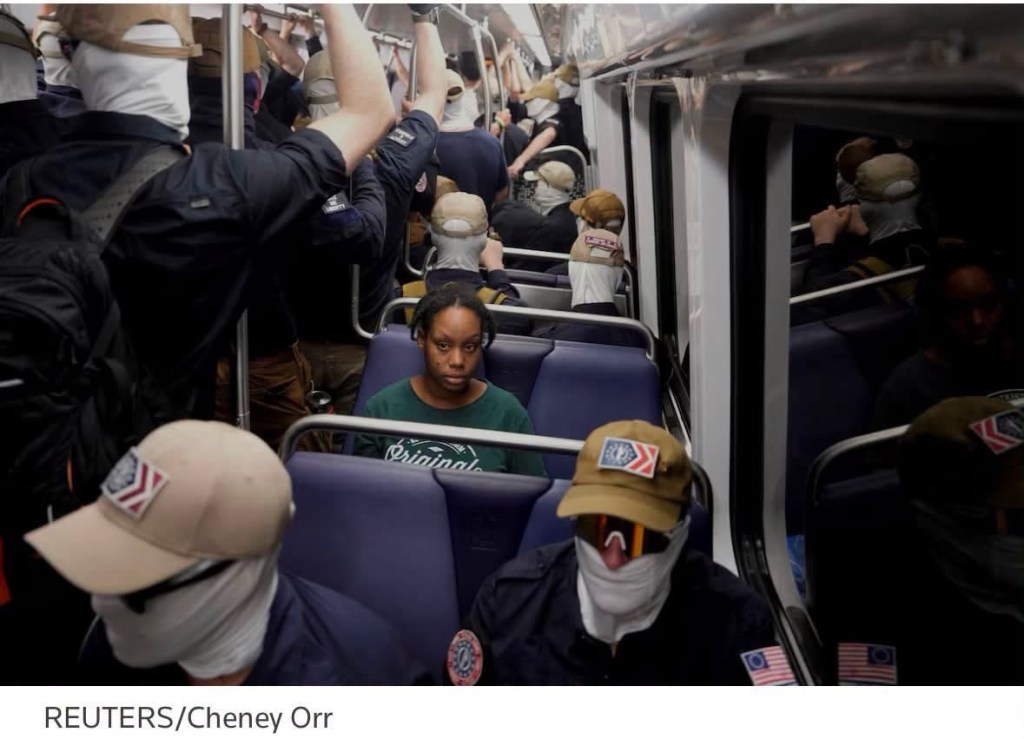
Today’s a new day! Here are my thoughts on this photo taken on the Metro in Washington, D.C. The following are my thoughts and opinions. If you happen to disagree with me, I encourage you to take it up with God.

Look at this photo. A young woman sits alone on a train, surrounded by dozens of men in matching uniforms, faces covered, patches bearing flags. She meets the camera’s eye. They refuse to be seen.

This image is a parable. And it’s the opposite of the Gospel.

The Gospel unmasks. Hate hides.

Jesus never hid His face. He wept publicly, prayed publicly, died publicly. “I have spoken openly to the world,” He told His accusers. (John 18:20)

Hate loves masks. It loves anonymity, mobs, and intimidation. Why? Because deeds done in darkness don’t survive the light (John 3:20). When an ideology needs to cover faces to deliver its message, it’s already confessed something about that message.

Christian Nationalism too often puts a mask on Jesus. It takes the crucified Savior and dresses Him in the uniform of earthly power. But Christ doesn’t need our flags stitched to His robe. “My kingdom is not of this world” (John 18:36). When we try to make it of this world, we end up looking like this train car: coercive, not compelling.

The Gospel draws near. Hate surrounds.

Notice the posture here. One person, isolated. Many others, standing, looming. That’s not how Jesus moved through crowds. 

He touched lepers when others stepped back. He invited Zacchaeus down from a tree when the crowd boxed him out. He stopped for the woman no one else would look at. The Gospel breaks circles of exclusion. Hate forms them.

Christian Nationalism, at its worst, baptizes “us vs. them.” It defines who belongs and who threatens. But the cross destroyed the dividing wall of hostility (Ephesians 2:14). If our faith needs an enemy to stay strong, it isn’t Christian faith. It’s civil religion with a cross necklace.

The Gospel sees the individual. Hate sees categories.

I don’t know the woman’s name in the photo. You don’t either. But God does. She isn’t a symbol. She’s a person made in His image (Genesis 1:27)

Movements built on hate don’t see people. They see demographics, threats, problems to solve. They make you afraid to sit alone on a train in your own city. 

Jesus’s first question to people was often, “What do you want me to do for you?” (Mark 10:51). He saw individuals. Christian Nationalism tends to see a “nation to save” and turns people into footnotes. When saving “America” matters more than loving the person next to you on the Metro, we’ve lost the plot.

So what do we do when the train car feels like the world?

Uncover our own faces: Confess where contempt has crept into our hearts. It’s easy to hate the masked men too. Jesus doesn’t give us that option. “Love your enemies” (Luke 6:27) includes them.

Sit with the isolated: Who in your life feels like that woman on the train? The Gospel moves us toward them, not away. Proximity kills caricatures.

Refuse the idols of power and fear: The early church changed the Roman Empire without voting, lobbying, or taking up swords. They did it by loving radically and dying well. Our witness still works that way.

Remember what we’re witnessing to: Not a Christian nation. A crucified Christ. “We preach Christ crucified… the power of God and the wisdom of God” (1 Corinthians 1:23-24). 

This photo should grieve us. Not just because of what it says about them, but because of what it reveals about us. Every one of those masked hearts was knit together by God. Every one of them is someone Christ died for. So is she. So are you. So am I.

Hate says, “Cover your face and find your strength in numbers.” 

Jesus says, “Take up your cross and find your life by losing it.”

The train is still running. The choice is still ours. Which kingdom will we board? ~OC

The Book Of Jude And Today’s Political Climate

Today’s a new day! 

As I have been studying the Book of Jude, here are some of my thoughts:

The Book of Jude may be one of the shortest books in the Bible, but its message feels remarkably relevant in today’s political climate. Written as a warning to believers, Jude addressed a culture filled with deception, division, and individuals who sought power for their own gain. While Jude was not writing about modern politics, many of the principles he shared can help us navigate the world we live in today.

A Warning About Deception

Jude urged believers to “contend for the faith” because certain individuals had slipped into positions of influence and were leading people away from truth. Today, we live in a world overflowing with information, opinions, and competing narratives. Politicians, media outlets, influencers, and commentators all seek to shape public opinion.

The challenge for Christians is not to blindly follow a political party, personality, or movement. Our ultimate allegiance belongs to Jesus Christ. Jude reminds us that truth matters and that believers must exercise discernment rather than simply accepting whatever aligns with their preferences.

The Pursuit of Power

One of Jude’s concerns was people who pursued their own interests rather than God’s purposes. In today’s political environment, it can sometimes seem that the pursuit of power has become more important than serving people.

Political leaders are human. Some enter public service with honorable intentions, while others may become consumed by influence, recognition, or personal agendas. Jude reminds us that God sees the heart and that positions of authority come with accountability.

As Christians, we should pray for our leaders, support what is righteous, and speak against what is unjust regardless of which side of the political aisle it comes from.

Division and Hostility

Perhaps one of the most obvious connections between Jude and our current culture is the growing spirit of division. Families are divided. Friendships are strained. Churches sometimes find themselves fractured over political disagreements.

Jude warned about those who caused divisions among people. Today, social media algorithms, political rhetoric, and constant news cycles often encourage outrage rather than understanding.

The enemy would love for believers to become so consumed with political battles that they neglect the mission of the Gospel. Christians are called to be peacemakers, not merely partisans.

Mercy in the Middle of Conflict

One of the most beautiful passages in Jude is his instruction to show mercy. Even while warning about false teaching, Jude encourages believers to reach out to others with compassion.

In our political conversations, mercy is often in short supply. It is easy to label people, dismiss them, or assume the worst about those who disagree with us. Jude challenges us to stand firmly for truth while extending grace to others.

Truth without love becomes harsh. Love without truth becomes compromise. The Gospel calls us to embrace both.

Keeping Our Eyes on Christ

The greatest lesson Jude offers for today’s political climate is that our hope is not found in Washington, political parties, elections, or government programs. Governments rise and fall. Political movements come and go. Kingdoms throughout history have appeared powerful only to disappear.

Jesus Christ remains King.

Jude concludes his letter with one of the most encouraging doxologies in Scripture, reminding believers that God is able to keep us from stumbling and present us blameless before His presence.

When political tensions rise, Christians must remember that our citizenship is first in the Kingdom of God. We should be informed citizens, engaged in our communities, and faithful in prayer, but our confidence must never rest in earthly leaders.

Final Thoughts

The Book of Jude speaks directly into a culture of confusion, deception, division, and competing voices. While political climates change from generation to generation, God’s truth remains constant.

Rather than placing our faith in politicians, we are called to place our faith in Christ. Rather than allowing politics to divide us, we are called to love one another. Rather than being consumed by fear about the future, we can trust the One who holds the future in His hands.

In a world filled with political noise, the message of Jude remains clear: stand firm in the truth, walk in mercy, and keep your eyes fixed on Jesus. ~OC

All-Time Low

The bar for character and respect among our politicians in America has been lowered so dramatically that it almost feels invisible. What once required integrity, humility, and a genuine sense of service now seems optional—so much so that you don’t even have to jump anymore to clear it. As Christians, this reality should not simply frustrate us; it should challenge us. Scripture reminds us in Philippians 4:8 to dwell on what is true, noble, right, pure, and admirable. When public leadership drifts from these values, it becomes even more important for believers to stand firmly in them, not just in what we expect from others, but in how we live our own lives.

It’s easy to point fingers at leaders and lament the cultural decline, but Jesus calls us to a higher standard. In Matthew 5:13–16, we are described as the salt and light of the world—preserving what is good and illuminating what is right. If the moral bar has fallen in politics, then the responsibility of Christians is not to lower our expectations, but to raise our witness. We are called to model respect, truthfulness, and grace in our conversations, even when others do not. Our hope is not in human leaders, but in God’s unchanging character. And through our daily actions, we can reflect His righteousness in a world that desperately needs it. ~OC

Don’t Back Down

Stand up for what’s right, don’t be swayed

By the voices that try to make you stray

Be brave, be strong, and hold your ground

Fight for justice, let truth be found

Raise your voice, let it be heard

Speak out against injustice, undeterred

Don’t let fear silence you, don’t back down

Stand firm, wear your heart in this town

Be a beacon of hope during the dark times

Shine your light, let it guide the way

For a brighter tomorrow, a better day

Stand up for what’s right, come what may

Your voice matters, your actions too

Make a difference, see it through

Stand up for what’s right, be bold

Create a world where love never grows old. ~OC

Juneteenth

Today’s a new day! Today is also Juneteenth. I want to share a few thoughts about this day and its significance in American history.

My journey to remembering and celebrating Juneteenth occurred later in life due to a lack of knowledge, as I was educated at a time where most school systems did not adequately teach on African American history and culture. (That’s why we can never return to those days). I believe the history of African Americans and their contributions to American society have often been overlooked or marginalized in traditional education systems. Learning about Juneteenth and understanding its significance can be a powerful awakening to the complexities of American history and the ongoing struggle for racial equality.

‍As I have learned more about Juneteenth, it serves as a reminder of both the injustices of the past and the resilience and perseverance of African Americans in the face of adversity. Juneteenth is not just a celebration of freedom from slavery but also a call to action for social justice and equality for all people. By remembering and celebrating Juneteenth, people of all races can honor the struggles and achievements of African Americans and work together towards a more just society. The journey of learning and growth is valuable not only for personal understanding but also for fostering greater empathy and solidarity across all communities.

‍It is never too late to learn and embrace aspects of history that may have been previously overlooked or omitted. Today, my call to action for you, for me, for communities across America is to be open to truly learning our history. All of our history. This will hopefully allow us to contribute to the broader effort of recognizing and honoring the diverse experiences and contributions of all individuals and communities.

Happy Juneteenth! ~OC

Just Imagine

Good Morning ! Here is another “Lost Writings from OC” from 2018. I believe it still has some meaning in 2025.

Today’s a new day! Indulge me for just a moment. If you were God and you were planning on coming to earth. What kind of role would you take on in society?

Would you be a wealthy CEO?

A powerful politician?

A celebrity with social media influence?

Or would you choose to become a poor child, on the run from violence and oppression?

I believe there is something profoundly significant about the fact that God’s own son walked this earth as an undocumented child refugee.

This was no accident.

It was part of the divine plan all along. Jesus could have been born and lived as a prince, a wealthy landowner or the Chief Priest. But instead He chose to become a refugee – forever linking himself with the most vulnerable people on earth:

Now after they had left, an angel of the Lord appeared to Joseph in a dream and said, “Get up, take the child and his mother, and flee to Egypt, and remain there until I tell you; for Herod is about to search for the child, to destroy him.” Then Joseph got up, took the child and his mother by night, and went to Egypt, and remained there until the death of Herod. ~Matthew 2: 13-15

So, God’s heart is very much for the refugee. His own Son chose to become a refugee. To the point where Jesus proclaimed that, “I was a stranger and you welcomed me in.”

Whatever you do for refugees you do for Him.

Your posture towards the “caravan” of refugees is your heart’s posture towards Jesus.

God even calls them his “brothers” as a reminder that those who suffer should be considered as family members that you woud invite over for Thanksgiving or a BBQ (Matthew 25:40).

There are few themes repeated in Scripture more than the call to care for the orphan, the widow and the alien (or foreigner):

“So you, too, must show love to FOREIGNERS, for you yourselves were once FOREIGNERS in the land of Egypt.” Deuteronomy 10:19

“Cursed is he who distorts the justice due a FOREIGNER, orphan, and widow. And all the people shall say, ‘Amen.’“ Deuteronomy 27:19

“Then I will draw near to you for judgment…against those who oppress the wage earner in his wages, the widow and the orphan, and those who turn aside the FOREIGNER and do not fear Me,” says the LORD of hosts. Malachi 3:5

So, how then should you and I respond, practically speaking, to what seems like an overwhelming refugee crisis?

There are four actions, I think, that would be Biblical, Christ-like responses to the humanitarian crisis that is currently unfolding. These are the ways I would want folks to respond if my own child or spouse were caught up in this refugee crisis:

SPIRITUALLY:

We must not lose hope.  We must not despair.  We must continue to to have Hope, because our world is not a closed system. God continues to infuse our world with hope, and Divine Love seeps through the cracks in our broken world.  Let’s continue to pray together for peace, for provision.  Let’s continue to petition and plead for, “On earth as it is in heaven….where there is no more pain or death or crying, and every tear is wiped away.”

1. Make them feel safe.

As refugees, they were forced to flee their country, leaving everything behind and running for safety with just the clothes on their backs. They’ve experienced much trauma. We should do whatever we can to make them feel welcome and safe.

2. Offer hospitality.

Perhaps the best thing you can do for refugees is to open your home to them. You can have them over for meals, or game night. You can invite them to social and family events so they can experience American culture at a Fourth of July cookout, a Thanksgiving dinner, or an Easter play.

3. Ask good questions.

When spending time with our new friends, we’ll have opportunities to ask them questions about their culture. We should be genuinely interested in them and their families. We can ask about their holidays and traditions, the things they do or don’t do, and why or why not. We might even try to learn some words in their language. Asking good questions shows them we care.

Christians should understand what it means to have someone care for you when you’re a stranger and foreigner. It’s what Jesus did for us.

4. Respect Over Fear

As we become friends with refugees, it’s imperative that we show love and respect. Not Fear.

Has Jesus not called us to love our neighbors, no matter the cost?

There is no fear in love. But perfect love drives out fear. (1 John 4:18)

Yes, this can be a difficult calling. Only love can overcome fear. And that is why I appeal to you on the basis of relationship and familial ties. What if that refugee child were your own flesh and blood? What if they were your own son or daughter? What mountain would you not climb? What politician would you not lobby? What price would you not pay to see them brought to safety.

Only the kind of love we usually reserve for family can overcome the fear and selfishness that teaches us to close our doors and turn away from the refugees plight. But Jesus calls us to a different way, the way of peace, radical welcome and laying down our lives for others.

Will you allow that love to compel you towards action today?

I pray you will take time to reflect on this post. How would God want you to treat the vulnerable? How can God use you during this crisis? ~OC

Christianity and Social Justice

Today’s a new day! I am always surprised and saddened when I hear the debate among Christians on the issue of social justice. That somehow the two cannot be part of a Christian’s life. In my own life, I believe my faith in Jesus and a desire to do His will goes hand-in-hand with doing social justice. I personally do not believe you can truly have one without the other. I cannot fully follow Jesus without serving those who are suffering and I cannot fully serve those who are suffering without an understanding and faith in Jesus. Without Jesus, I can never fulfill more than the surface-level needs of those I am trying to serve.

This is where I believe the Church needs to take a stand. People of faith should be the biggest supporters for social justice. I believe if we want to truly live out the teachings of Jesus, Christianity would be synonymous with social justice. I think the Church needs to challenge itself to see how we can be a place where a faith in Christ and social justice are so intertwined they cannot be separated from each other. How can we help a lost world to better understand the connection between God and social justice? There is a lot of talk on blogs, social media, and even in church pulpits about how the church can stop losing its influence on the world. I think the answer lies in helping people understand just how close justice is to the heart of God.

I know some reading this might disagree with my thoughts and views on Christianity and Social Justice, but I pray you will take some time to see how you can better serve Jesus, by serving others. ~OC

The Power of One

Today’s a new day! More importantly, it’s Rosa Parks Day. On December 1, 1955, Rosa Parks changed the course of history with one act. Ms. Parks refused to give up her seat on the city bus to a white passenger, as the unjust law demanded her to do during that time of American History. She was removed from the bus and arrested. Yet her spontaneous defiance sparked the ensuing Montgomery Bus Boycott, a movement of blacks and whites that took shape within hours of her arrest and advanced the civil rights movement across the United States. The boycott lasted 381 days. A time in which black commuters walked, rode bikes, or accepted rides from sympathetic supporters — until a district court ruling declared bus segregation unconstitutional. This ruling was upheld by the U.S. Supreme Court, striking down the practice across the country. And this was just the beginning: the boycott galvanized a national network of support, and created a framework of committed activists, that would form the backbone of the civil rights movement for decades to come. ~OC

“People always say that I didn’t give up my seat because I was tired, but that isn’t true. I was not tired physically… No, the only tired I was, was tired of giving in.” ~Rosa Parks

Blog at WordPress.com.

Up ↑