When We Care More About Position Than Protection

Today’s a new day!

I know many people may disagree with what I am about to say, and that’s okay. Healthy disagreement is part of life and part of the Church. But I stand firmly by these words.

I care far more about the victims of abuse in our churches than I do about whether a woman teaches a Bible study, preaches a sermon, or stands behind a pulpit in a Southern Baptist Church—or any other church.

For years, countless hours, meetings, conferences, articles, and social media debates have focused on the role of women in ministry. Entire denominations have wrestled with the question. Churches have split over it. Christians have passionately argued both sides.

Yet while some believers are consumed with debates about who is allowed to speak from the platform, children, teenagers, and vulnerable adults have suffered abuse in churches that were supposed to be safe places.

That should break our hearts.

When Jesus walked this earth, He consistently placed people above power, compassion above control, and protection of the vulnerable above religious posturing. He reserved some of His strongest words for religious leaders who burdened others while neglecting justice, mercy, and faithfulness.

I cannot help but wonder what Jesus thinks when churches spend more energy debating who can preach or teach than they spend ensuring children are protected.

I cannot help but wonder what He thinks when victims are ignored, silenced, questioned, or blamed while church leaders focus on preserving reputations and institutions.

The Church should be the safest place on earth for a child.

The safest place for a survivor.

The safest place for the wounded.

The safest place for those seeking healing.

And yet, too often, it has not been.

This is not a statement against theology. 

Theology matters. Scripture matters. Church governance matters. But if our theological discussions become more important than protecting people made in the image of God, something has gone terribly wrong.

If Christians are more concerned about a woman’s role in ministry than they are about children being abused, they have missed something essential in the teachings of Jesus.

If we can passionately argue about positions while remaining silent about victims, we need to examine our priorities.

If we are quicker to defend institutions than to defend the brokenhearted, we need to return to the heart of Christ.

Jesus welcomed children.

Jesus protected the vulnerable.

Jesus stood with the hurting.

Jesus confronted religious leaders who had lost sight of what mattered most.

The Church should do the same.

The world is watching how we respond. More importantly, survivors are watching.

They don’t need another debate.

They need safety.

They need accountability.

They need justice.

They need compassion.

They need to know that the Church values their well-being more than its reputation.

My prayer is that Christians of every denomination would become known not merely for what we believe, but for how fiercely we protect the vulnerable, how seriously we take abuse allegations, how compassionately we care for survivors, and how faithfully we reflect the heart of Jesus.

Because at the end of the day, protecting the vulnerable is not a political issue.

It is not a denominational issue.

It is not a conservative issue or a progressive issue.

It is a Jesus issue. ~OC

African American Librarians

The following information was provided by the Portland Public Library. We can never stop learning and being thankful.

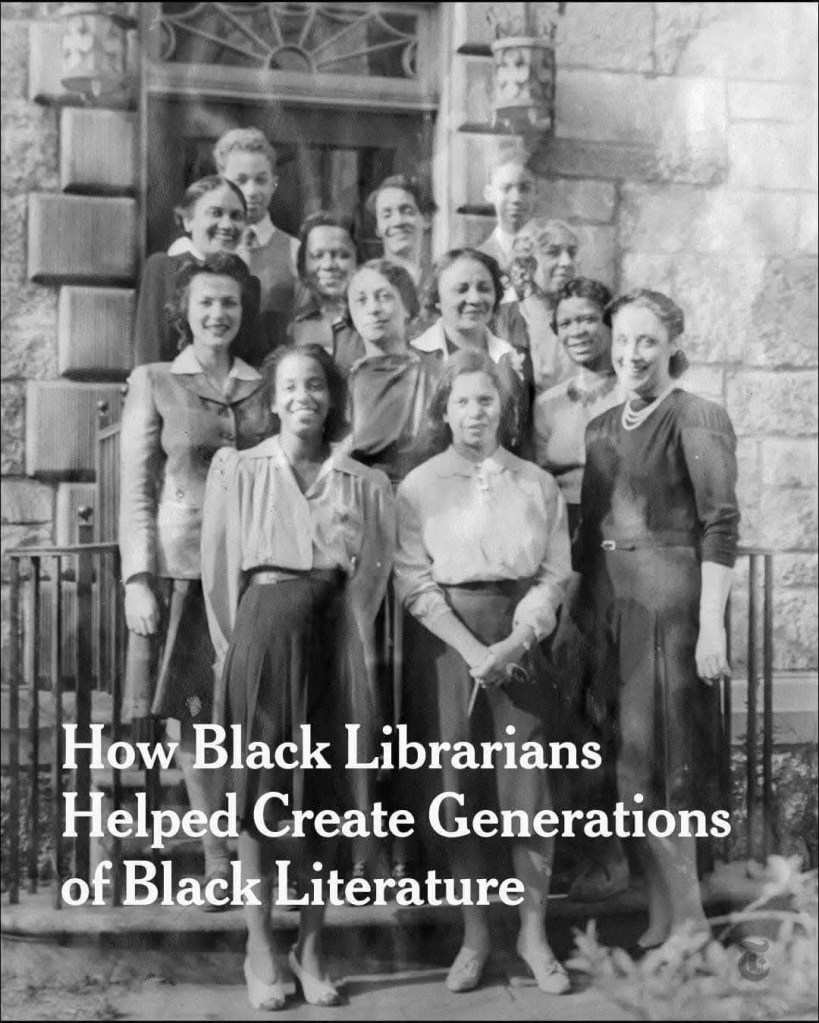
Black librarians have played a vital role in preserving generations of Black literature and bringing new resources and opportunities to libraries for decades.

Before emancipation, Black people in the South were punished for reading or teaching others to read. However, during the Harlem Renaissance, a movement emerged to provide access to reading material on Black history.Women were the institution builders.’

Many Black women who were the first to attend library school created their own methods after learning ones that weren’t suited to Black books and ideas.

“In many ways, it is these women who were the institution builders,” Joy Bivins, the director of the Schomburg Center for Research in Black Culture, told The New York Times.The outlet reported that while library services for Black citizens were unavailable in the South and limited in the North, branches that did serve them often had few books geared to their interests and sometimes lacked card catalogs or reference collections.

This began to change in 1924 when Vivian Harsh became the first Black librarian to lead a public library branch in Chicago. In 1932, she led the city’s first branch in Bronzeville, a Black neighborhood, welcomed Black history study groups and established the nation’s second public library collection dedicated to Black life and literature, according to the Times.However, according to the outlet, Harlem captured the transformations of the era more when, starting in 1920, a white librarian named Ernestine Rose hired four young Black librarians at the 135th Street library.

Improving faulty Dewey decimal categories

For Black librarians, cataloging often meant “countercataloguing,” per the Times.

As Black collections moved from private homes to institutions, quirky personal systems no longer sufficed, and the systems used in most libraries proved inadequate as they allowed limited space for non-European subjects.

Dorothy Porter, a librarian at Howard University, and others adjusted the Library of Congress’ standard subject headings, adding ones for topics such as passing, Pan-Africanism and the blues. She also addressed the racism embedded in the Dewey decimal classification system.This system, created in the 1870s, categorized knowledge in ways that marginalized Black experiences, confining them to narrow numerical slots.

Despite warnings that she might face copyright infringement for her modified system, an unauthorized version was adopted at the Schomburg Center and other places.

Today, as the field of library and information science has seen calls to ban more books, change the way the field selects material for public library use, and, in many ways, minimize the importance of librarians in their communities, it is more important than ever to remember those who challenged oppression, racism, and erasure. The percentage of Black librarians in the United States remains in the single digits. However, we will continue to push for representation, access to information, and lifelong learning as a right for all. The African American librarians who fought to preserve that right are among the many reasons we acknowledge and celebrate Women’s History Month. ~OC

Blog at WordPress.com.

Up ↑