What I Look For In A Leader

Today’s a new day!

As followers of Jesus, we are called to pray for those in authority (1 Timothy 2:1–2). We are also called to exercise wisdom and discernment when evaluating the character of those who seek to lead.

When I consider a political candidate, my first question isn’t, “What party do they belong to?” My question is, “What kind of person are they becoming?”

These are some of the qualities I look for.

I look for a joyful heart. Not a manufactured smile for the cameras, but a genuine joy that reflects gratitude, humility, and hope. Scripture reminds us that “the joy of the Lord is your strength” (Nehemiah 8:10). A joyful heart often points to a soul that isn’t driven solely by fear, anger, or resentment.

I look for a clear mind that produces clear thoughts and the ability to express those thoughts with maturity. Leadership requires wisdom. Decisions affect millions of lives, and words have the power to unite or divide. Mature communication matters.

I look for self-restraint. In a culture that rewards outrage and impulsive reactions, self-control is becoming increasingly rare. Yet Scripture calls self-control one of the fruits of the Spirit (Galatians 5:22–23). A leader who cannot govern themselves will struggle to govern wisely.

I look for someone who values people more than power. Power should never become the goal; it should be a tool used to serve others. Jesus, the greatest leader who ever lived, washed the feet of His disciples instead of demanding they serve Him. That is the model of leadership I admire.

I look for someone who respects people—even those who disagree with them. We don’t have to agree with everyone to treat them with dignity. Every person bears the image of God. Civility is not weakness; it is evidence of maturity.

I look for someone who can receive constructive criticism. None of us has all the answers. Wise leaders surround themselves with truth-tellers instead of yes-men. Humility allows correction to become growth instead of offense.

Finally, I look for a heart that produces both kindness and strength. Kindness without conviction can become compromise. Strength without kindness can become cruelty. Jesus embodied both perfectly. He stood firmly for truth while extending extraordinary compassion to people who were hurting.

As I look across today’s political landscape, I find myself longing to see these qualities displayed more consistently in our leaders. That longing isn’t about one party or another. It reflects a desire for leadership that more closely resembles the character Scripture commends.

Perhaps the greatest challenge isn’t simply asking whether our leaders possess these qualities.

Perhaps it’s asking whether we do.

Are we joyful?

Are we self-controlled?

Do we value people over winning arguments?

Do we listen well?

Do we show kindness without abandoning truth?

The Church should be known for these qualities long before we expect them from Washington, our state capitals, or city halls.

Our ultimate hope has never rested in a president, governor, senator, or political party. Our hope rests in Jesus Christ—the King whose kingdom cannot be shaken.

So let us pray for our leaders. Let us vote with wisdom. Let us speak with grace. And above all, let us live in such a way that the character of Christ shines through us, regardless of who occupies positions of earthly authority.

Because while elections shape nations, transformed hearts change the world. ~OC

Dear Christian Community: The World Isn’t Rejecting Jesus

Dear Christian Community,

I have spent countless hours talking with people who don’t attend church, who have walked away from the faith, or who have never considered following Jesus.

One thing has become increasingly clear.

Most of them are not rejecting Jesus.

They are rejecting what they have seen from many who claim to represent Him.

They have read about the Jesus who welcomed sinners, touched lepers, defended the broken, forgave His enemies, washed His disciples’ feet, and willingly gave His life on a cross for the salvation of the world.

Then they look at much of modern Christianity.

Instead of humility, they see arrogance.

Instead of compassion, they see outrage.

Instead of mercy, they see judgment.

Instead of sacrificial love, they often see a relentless pursuit of political influence and cultural power.

Some churches have become so consumed with defending political ideologies that the Gospel has been pushed to the background. Sermons increasingly sound like campaign speeches. Social media feeds often reflect more passion for political victories than for seeing lost people encounter Jesus.

When political identity becomes more important than our identity in Christ, something has gone terribly wrong.

Jesus never called us to build earthly kingdoms.

He called us to build His Kingdom.

He never instructed His followers to place their hope in governments, political parties, or elected officials. He told us to seek first the Kingdom of God and His righteousness. He commanded us to love God with all our heart and to love our neighbors as ourselves.

Our greatest weapon has never been political power.

It has always been the love of Christ.

The early Church transformed the world without controlling governments. They had no political majority, no cultural influence, and no worldly authority. Yet they turned the world upside down because they loved extravagantly, served sacrificially, forgave freely, and boldly proclaimed the resurrection of Jesus Christ.

That same Gospel still changes lives today.

But if we replace it with political tribalism, people will naturally conclude that Christianity is simply another ideology competing for influence.

The Church should never become known more for its political preferences than for its love.

Jesus said the world would know we are His disciples by our love for one another—not by our voting record, our online arguments, or our ability to win cultural battles.

This isn’t a call to withdraw from society or to stop caring about important issues. Christians should engage the world with wisdom, conviction, and courage.

But our highest allegiance must always belong to Jesus Christ.

The Gospel is too beautiful to be overshadowed by partisan division.

If people reject Jesus after seeing His love, hearing His truth, and encountering His grace, that is their decision.

But may they never reject Him because we failed to reflect Him.

Church, perhaps it’s time to ask ourselves some difficult questions.

Are we known more for making disciples or making political statements?

Do people see Christ when they look at us?

Are we carrying our cross—or merely carrying our preferred ideology?

The world desperately needs Jesus.

Let’s make sure they actually get to see Him.

May our churches once again become places where grace is abundant, truth is spoken in love, the hurting are welcomed, the forgotten are seen, and every person encounters the transforming hope found only in Jesus Christ.

Because the world doesn’t need a more politically powerful Church.

It needs a more Christlike one.

Relentless Consistency

Today’s a new day!

We live in a world that celebrates the spectacular.

The viral moment.
The overnight success.
The mountaintop experience.

But the Kingdom of God often grows in a much quieter way.

It’s built through relentless consistency.

Faith isn’t measured by how loudly we worship on Sunday morning. It’s measured by whether we still trust Him on Monday afternoon, Wednesday evening, and Friday when life doesn’t make sense.

Anyone can be passionate for a moment.

lAnyone can be inspired after a great sermon,incredible worship service, or a spiritual conference.

But what happens when the music stops?

What happens when the prayers seem unanswered?

What happens when the miracle hasn’t arrived yet?

That’s where relentless consistency begins.

Jesus never called us to be occasional disciples.

He called us to follow Him daily.

Daily taking up our cross.

Daily loving our neighbors.

Daily forgiving those who hurt us.

Daily praying for those who oppose us.

Daily choosing grace over bitterness.

Daily choosing faith over fear.

Daily choosing obedience over convenience.

The Apostle Paul compared the Christian life to a race—not a sprint, but one that requires endurance. The finish line isn’t reached by one incredible burst of speed. It’s reached by putting one faithful foot in front of the other, again and again.

Relentless consistency doesn’t mean perfection.

It means getting back up every time you fall.

It means opening God’s Word even when you don’t feel like it.

It means praying even when the heavens seem silent.

It means serving even when no one notices.

It means loving even when love isn’t returned.

It means worshiping even through tears.

The beautiful thing about consistency is that it builds spiritual roots.

Storms may bend the tree, but deep roots keep it standing.

When our relationship with Christ is built on daily faithfulness instead of emotional highs, we become anchored in His promises rather than our circumstances.

The world may never applaud consistency.

Social media rarely celebrates the person who quietly prays every morning.

Few people notice the believer who faithfully encourages others, serves behind the scenes, gives generously, and walks humbly with God.

But Heaven notices.

Our Father sees every unseen act of obedience.

Every whispered prayer.

Every quiet sacrifice.

Every act of kindness.

Every moment we choose Christ over ourselves.

Galatians reminds us not to grow weary in doing good, for at the proper time we will reap a harvest if we do not give up.

Notice it doesn’t say if we become famous.

It says if we do not give up.

Perhaps revival doesn’t begin with a stadium full of people.

Perhaps it begins with one believer deciding that today they will follow Jesus again.

And tomorrow they will do the same.

And the next day.

And the day after that.

Relentless consistency isn’t glamorous.

It’s holy.

It’s choosing Jesus over and over until the rhythm of faith becomes the rhythm of your life.

So if you’re tired today…

Keep praying.

Keep trusting.

Keep serving.

Keep loving.

Keep forgiving.

Keep showing up.

Keep walking with Jesus.

Because the God who is always faithful is using your relentless consistency to shape you into the image of His Son.

You may not see all that He is doing today.

But one day you’ll look back and realize that every ordinary step of obedience became part of His extraordinary story.

Keep going.

He isn’t finished with you yet. ~OC

Loving Our Immigrant Neighbors

Today’s a new day! 

One of the most beautiful truths found throughout Scripture is this: every person is created in the image of God.

That truth doesn’t stop at a border.

It doesn’t depend on the language someone speaks, the color of their passport, or the country they once called home.

It is a truth that reminds us that every person has immeasurable value because they are loved by their Creator.

Today, my heart is especially drawn toward the immigrant community.

Behind every journey is a story.

Some came seeking opportunity. Others came to reunite with family. Some fled violence, persecution, or desperate circumstances. Many have sacrificed everything they knew in the hope of building a safer, better future for those they love.

While every person’s story is different, one thing remains the same: they deserve to be treated with dignity, kindness, and respect.

As followers of Jesus, our first response should never be fear or indifference. Our first response should be love.

Throughout His earthly ministry, Jesus consistently noticed the people others overlooked. He welcomed those on the margins, showed compassion to those in need, and reminded us that loving our neighbor is not optional—it is central to following Him.

Loving our immigrant neighbors does not require us to agree on every political question or every policy debate. Faithful Christians can hold different views about immigration laws and border security while still agreeing that every human being deserves compassion and should be treated with dignity.

The Gospel calls us to something higher than winning arguments.

It calls us to love.

That love may look like volunteering with a local ministry, helping a family learn English, providing meals, supporting legal aid ministries, mentoring children, offering friendship to someone who feels alone, or simply taking the time to listen to another person’s story.

Sometimes the greatest ministry begins with seeing someone who feels invisible.

The Church has an incredible opportunity to reflect the heart of Christ.

Imagine churches becoming places where newcomers find hope instead of suspicion, friendship instead of isolation, and grace instead of rejection.

Imagine believers praying not only for their own families but also for the families who have traveled difficult roads in search of safety, stability, or a new beginning.

The love of Christ has always crossed every barrier humanity has tried to build.

When we remember that, our hearts begin to change.

Today, let’s pray for immigrant families in our neighborhoods and throughout the world. Pray for their safety, for wisdom for those making difficult decisions, for churches to faithfully serve their communities, and for our leaders as they seek solutions that uphold both justice and compassion.

Then ask the Lord a simple but life-changing question:

“Jesus, how can You use me to love my neighbors today?”

Because prayer is never meant to end with “Amen.”

Prayer changes us.

Prayer opens our eyes.

Prayer moves our hands and feet.

May we become known as people who welcome others with the same grace that Christ has shown us.

One day, people from every tribe, every language, every nation, and every people will stand together before the throne of God, worshiping Jesus with one voice.

Until then, may we live as citizens of His Kingdom—loving generously, serving humbly, praying faithfully, and reflecting the heart of Christ to everyone we meet.

Prayer:

Dear God, we lift up immigrant families around the world and in our own communities. You know every journey, every fear, every hope, and every need. Protect those who are vulnerable, comfort those who are grieving, strengthen families facing uncertainty, and provide opportunities for peace and flourishing. Give wisdom to our leaders as they make difficult decisions, and help Your Church to be a place of compassion, truth, and hope. Teach us to love our neighbors as You have loved us, so that our lives point others to Jesus Christ. In His powerful and holy name we pray, Amen.

Hope Isles: A New Beginning/Chapter Fifteen- New Doors

For a few moments, nobody moved.

Sarah stood a few feet away from James.

James stood beside his car.

The evening sunlight painted the front porch of Hope House in shades of gold and amber.

Everything felt strangely familiar.

And completely different.

Home had a way of doing that.

Finally Sarah laughed.

“Are you planning on standing there all night?”

James grinned.

“I was considering it.”

“Well don’t.”

She stepped forward and hugged him.

The embrace caught him off guard.

Not because it was unexpected.

Because it felt natural.

Like he’d never left.

When they stepped apart, Ethan appeared behind her.

“You took your sweet time.”

James laughed.

“It’s good to see you too.”

Ethan pulled him into a quick hug.

“Seriously, though. Welcome back.”

One by one the others gathered.

Smiles.

Handshakes.

Questions.

Laughter.

The kind of welcome that couldn’t be manufactured.

It had to be lived.

And somehow Hope Isles always seemed to know how to do it.

Later that evening everyone gathered around the large dining room table.

Stories were exchanged.

Coffee was poured.

Someone brought pie.

No one could remember who.

Which somehow made perfect sense.

At one point James found himself simply watching.

Listening.

Taking it all in.

The conversations.

The friendships.

The warmth.

For years he’d searched for belonging in all the wrong places.

Only to discover it waiting for him here.

Across the table Sarah noticed him smiling.

“What?”

James shook his head.

“Nothing.”

“That’s never true.”

He laughed.

“I just missed this.”

The room grew quiet.

Not awkwardly.

Meaningfully.

Then June pointed a fork at him.

“We missed you too.”

The emotion behind her words was impossible to ignore.

James looked down for a moment.

Humbled.

Grateful.

Home.

The word carried more weight than ever before.

After dinner, as people began drifting toward their rooms, Sarah stopped James near the front porch.

“Walk with me?”

He nodded.

The island air felt cool and refreshing after the heat of the day.

Together they followed a path that wound toward the shoreline.

The moon reflected off the water.

The waves moved gently against the shore.

Neither felt rushed to speak.

Finally Sarah broke the silence.

“How’s your father?”

James looked out across the water.

The question hurt.

But not in the same way anymore.

“Still fighting.”

Sarah nodded.

“And you?”

That question took longer to answer.

James thought carefully.

“I’m healing.”

Sarah smiled softly.

“That’s a good answer.”

They continued walking.

Eventually they reached an old wooden bench overlooking the water.

The same bench where countless conversations had happened over the years.

James sat down.

Sarah joined him.

For several moments they simply watched the waves.

Then Sarah spoke again.

“You know, while you were gone something happened.”

James turned toward her.

“What?”

“A letter arrived.”

His brow furrowed.

“For me?”

She nodded.

“I didn’t open it.”

“Where is it?”

Sarah smiled.

“In your room.”

James frowned.

“That’s not ominous at all.”

“It wasn’t supposed to be.”

“But it is.”

Sarah laughed.

“Then mission accomplished.”

Back at Hope House, James climbed the stairs to his room.

Everything looked exactly as he’d left it.

Yet somehow it felt different.

The room no longer felt temporary.

It felt claimed.

Lived in.

A place rooted in purpose.

Sitting on the desk was a single envelope.

His name written across the front.

No return address.

No explanation.

Just:

James Carter.

He picked it up.

Turned it over.

Nothing.

For a moment he considered waiting until morning.

Instead he opened it.

Inside was a handwritten note.

Only one page.

Only a few lines.

But enough to stop him cold.

The message read:

James,

If you’re reading this, then you’ve finally come home.

There are things about Hope Isles you don’t know.

Things about its past.

Things about your connection to it.

When you’re ready, meet me at the old lighthouse.

Come alone.

Sunrise.

No signature.

No clue.

Nothing.

James read it again.

And again.

His pulse quickened.

A connection to Hope Isles?

What connection?

He had arrived as a stranger.

Hadn’t he?

The questions multiplied by the second.

A knock at the door startled him.

Ethan stepped inside.

“You okay?”

James quickly folded the letter.

“Yeah.”

Ethan narrowed his eyes.

“That sounded suspicious.”

“I’m fine.”

“Now it sounds even more suspicious.”

James laughed despite himself.

Eventually Ethan left.

But sleep never came easily that night.

The letter remained on the nightstand.

Waiting.

The lighthouse sat at the far edge of the island.

Silent.

Watching.

As it had for decades.

And long after Hope House had gone quiet, James stared out the window toward the darkness.

Wondering.

Questioning.

Waiting for morning.

Because something was coming.

Something bigger than his return.

Something tied to the island itself.

And as the first hints of dawn began touching the horizon, the old lighthouse stood against the sky like a sentinel.

Keeping secrets.

For now.

To Be Continued…

Hope Isles: A New Beginning/ Chapter Fourteen-The Journey Home

The morning arrived with a quiet certainty.

Not excitement.

Not anxiety.

Just certainty.

James loaded his bag into the back seat of his car as the sun climbed above the horizon.

For a moment he stood there, looking at the house.

The place that held so much pain.

And somehow, healing.

Not complete healing.

But enough.

His father stepped onto the porch.

“You leaving already?”

James smiled.

“You knew I would.”

“Still doesn’t mean I have to like it.”

That earned a laugh from both of them.

The laughter faded, replaced by a comfortable silence.

The kind that no longer felt awkward.

His father walked down the steps slowly.

Every movement reminding James that time was no longer something either of them could take for granted.

When he reached him, neither man seemed sure what to do.

Years of distance don’t disappear overnight.

Then his father simply opened his arms.

James hesitated for only a second before stepping forward.

The embrace was brief.

But real.

“I love you, son.”

The words came quietly.

Without drama.

Without apology attached.

Just truth.

James swallowed hard.

“I love you too.”

For years he never thought he would say those words again.

Now they came easier than expected.

His father stepped back.

“Go.”

James frowned.

“That’s it?”

His father smiled.

“If I keep talking, I’ll start crying.”

James laughed.

“So will I.”

“Then let’s not do that.”

One final handshake.

One final nod.

And then James climbed into the car.

As he drove away, he looked once in the rearview mirror.

His father remained standing there.

Watching.

Not with sadness.

With peace.

For the first time in years, neither of them was carrying the weight alone.

The road stretched ahead.

Miles of pavement.

Miles of memories.

Miles of unanswered questions.

Yet for the first time in a long time, James wasn’t afraid of what waited at the end.

Because Hope Isles wasn’t just a destination anymore.

It was home.

Hours later, his phone rang.

The caller ID made him smile.

June.

He answered.

“Hello?”

There was a pause.

Then June spoke.

“You heading south?”

James nearly slammed on the brakes.

“How do you know that?”

“I have my sources.”

“You don’t have sources.”

“I absolutely have sources.”

James laughed.

“Who told you?”

“No one.”

“June.”

“No one.”

A pause.

Then she added:

“But the blueberry muffins burned this morning.”

James frowned.

“What does that have to do with anything?”

“It always happens when something important is about to happen.”

He shook his head.

“That makes absolutely no sense.”

“Yet here we are.”

Before he could argue, she hung up.

James laughed all by himself.

Somehow that felt good.

Back in Hope Isles, June placed the phone down.

Joe stared at her.

“You called him.”

“I did.”

“And?”

June smiled.

“He’s coming.”

Joe sighed.

“How do you always know?”

June pointed upward.

“I don’t.”

Joe followed her gaze.

“The weather?”

“No.”

“What then?”

June grinned.

“God.”

Joe rolled his eyes.

Yet even he couldn’t hide his smile.

At Hope House, Sarah was organizing paperwork when Ethan burst through the door.

“Something’s different.”

Sarah looked up.

“What?”

“I don’t know.”

She stared at him.

“That’s incredibly helpful.”MJ

Ethan ignored the comment.

“I just feel it.”

Sarah laughed.

“Feel what?”

“Like something is changing.”

She shook her head.

“You’ve been spending too much time around June.”

“Probably.”

Still, after Ethan left, Sarah found herself standing at the front window.

Looking toward the road.

Again.

Not waiting.

Not expecting.

Just wondering.

Late that afternoon, James crossed the bridge leading toward the island.

The familiar water sparkled beneath the sunlight.

The sight instantly stirred something inside him.

Memories.

Conversations.

Second chances.

Friendships.

Faith.

The bridge seemed shorter than he remembered.

Or maybe his heart was simply lighter.

As the welcome sign came into view, he slowed down.

The words stood there exactly as they always had.

WELCOME TO HOPE ISLES

Where Nobody Walks Alone.

James smiled.

When he first arrived, he hadn’t believed those words.

Now he knew they were true.

As he drove through town, little had changed.

The diner.

The church.

The bookstore.

The marina.

The familiar streets felt like old friends waiting patiently for his return.

And somehow they had.

When he finally pulled into the gravel drive of Hope House, he simply sat there.

Hands resting on the steering wheel.

Heart beating faster than expected.

This was it.

Not a visit.

Not a stop along the way.

Home.

The front door opened.

Sarah stepped outside.

For a moment neither of them moved.

Neither seemed sure what to say.

Weeks of distance.

Months of change.

An entire journey standing

And suddenly every mile felt worth it.

James stepped out of the car.

Sarah walked toward him.

“Welcome home.”

The words were simple.

Yet they carried everything.

James looked around at Hope House.

At the porch.

At the people gathering in the doorway.

At the life waiting for him.

And for the first time since leaving

he knew with absolute certainty.

This was exactly where he was supposed to be.

But as the evening sun settled over Hope Isles, another story was quietly beginning.

Because homecomings have a way of opening doors.

And some of those doors lead to places no one expected.

Especially James.

To Be Continued…

The A Side And The B Side

Today’s a new day!

I am old enough to remember vinyl records.

Yes, I know vinyl has made an incredible comeback over the last several years, and I love seeing younger generations discover the warmth and beauty of a record spinning on a turntable. But I remember when vinyl wasn’t “retro”—it was simply how we listened to music.

Back then, every 45 RPM record had two sides.

The A Side was the song everyone knew. It was the hit. It was the song the radio stations played over and over. It climbed the charts, filled concert arenas, and became the soundtrack to people’s lives.

Then there was the B Side.

The B Side was different. It wasn’t always a chart-topper. Most people never heard it unless they bought the record. Sometimes it was experimental. Sometimes it was deeply personal. Sometimes it became a hidden treasure that devoted fans loved even more than the hit song.

I’ve been thinking lately…

Isn’t that a lot like us?

We all have an A Side and a B Side.

Our A Side is what we willingly show the world. It’s our smiles, our accomplishments, our family photos, our promotions, our victories, our carefully chosen words, and the version of ourselves we hope others admire.

It’s polished.

It’s presentable.

It’s what we want everyone else to hear.

But then there’s the B Side.

The B Side holds our fears.

It carries our disappointments, regrets, doubts, failures, grief, hidden tears, unanswered prayers, and private battles that few people ever see.

It’s the side we often try to keep tucked away.

The truth is, God isn’t impressed by our A Side because He already knows our B Side.

Before we ever spoke our first word, He knew every chapter of our story.

He knows every wound we’ve tried to hide.

Every scar we’ve covered.

Every question we’ve been afraid to ask.

Every tear we’ve cried when no one else was watching.

And here’s the beautiful part…

He doesn’t love us in spite of our B Side.

He loves us completely—including our B Side.

Jesus never looked for perfect people.

He sought broken people.

He welcomed doubters.

He embraced outcasts.

He forgave failures.

He restored those who thought their story was over.

While society often rewards polished appearances, Jesus specializes in transformed hearts.

The Apostle Paul understood this when he wrote that God’s power is made perfect in weakness. 

Our weaknesses are not obstacles to God’s grace—they are often the very places where His grace shines brightest.

Perhaps that’s why some of the most powerful testimonies aren’t found on someone’s A Side.

They’re found on the B Side.

The addiction that Jesus broke.

The marriage He restored.

The depression He carried someone through.

The cancer battle that strengthened faith.

The years of wandering before coming home.

The loss that deepened trust.

The miracle that was born from unimaginable pain.

Those are the songs that reveal God’s faithfulness.

Maybe you’ve spent years trying to hide your B Side.

Maybe you’re afraid that if people knew your struggles, they would think less of you.

But Jesus already knows.

And He still calls you His beloved.

In fact, He can use the very chapters you’re most tempted to hide to encourage someone who is walking through a similar valley.

The enemy whispers, “Hide your B Side.”

Jesus says, “Let Me redeem it.”

The enemy says, “You’re defined by your failures.”

Jesus says, “You’re defined by My grace.”

The enemy wants us to pretend.

Jesus invites us to be transformed.

Maybe it’s time to stop living only from our A Side.

Maybe it’s time to let God’s grace rewrite the song on our B Side.

Because sometimes the most beautiful music isn’t the song everyone knows.

It’s the one written in the quiet places where God met us in our brokenness, carried us through the storm, and turned our pain into a testimony.

After all, the greatest story ever told wasn’t about people who had everything together.

It was about a Savior who came for people whose records had been scratched, whose hearts had been broken, and whose lives needed redemption.

And because of Jesus, even our B Side can become a song of hope.

Reflection

What’s on your B Side today?

Whatever it is, don’t hide it from the One who already knows every note. Bring it to Jesus. He is the Master Redeemer, and He has a way of taking the songs we thought would never be heard and turning them into testimonies that point others to His love, grace, and saving power.

Sometimes the song God uses most isn’t the one the world applauds.

It’s the one that reveals His amazing grace. ~OC

The Words Of A President Matter

Today’s a new day!

The words of a President matter.

They always have, and they always will.

The President of the United States holds one of the most influential voices in the world. Every speech, every interview, every social media post, and every public statement carries weight. Those words have the power to calm fears, inspire hope, strengthen democracy, and remind us that, despite our differences, we are one nation.

They also have the power to deepen wounds.

In recent years, political rhetoric has become increasingly hostile. It has become common to hear entire groups of Americans labeled as “evil,” “enemies,” or people beyond redemption simply because they belong to a different political party.

That kind of language is dangerous.

There are certainly evil actions in this world. There are policies we may strongly oppose. There are decisions that deserve criticism and leaders who should be held accountable. Democracy depends upon honest debate and the free exchange of ideas.

But there is a profound difference between challenging ideas and condemning millions of people.

Healthy debate strengthens a republic.

Demonizing one another weakens it.

One of the highest callings of the presidency is not merely to govern—it is to unite. While no president can eliminate every disagreement, the office carries a unique responsibility to remind Americans that we share a common future, even when we disagree about the path forward.

Unity does not require uniformity.

It does not mean everyone votes the same way or holds identical beliefs.

It means remembering that our political opponents are still our fellow citizens. They are our neighbors, coworkers, family members, veterans, teachers, nurses, police officers, pastors, small business owners, and friends. We may passionately disagree with one another, but disagreement alone does not make someone evil.

History reminds us that nations become strongest not when everyone agrees, but when people learn how to disagree without hatred.

Civil debate is essential.

Respectful disagreement is healthy.

Listening is powerful.

But when our language convinces us that those on the other side are no longer fellow Americans—but enemies to be feared or hated—we begin to lose something far more valuable than an election.

We begin to lose one another.

As Christians, this challenge carries even greater weight. Scripture calls us to “speak the truth in love” and reminds us that every person is created in the image of God. We are called to love our neighbors, pray for our leaders, and overcome evil with good—not to fuel hatred with harsher words.

Our nation desperately needs leaders who will lower the temperature instead of raising it.

Leaders who challenge without demeaning.

Leaders who persuade without insulting.

Leaders who remember that the presidency belongs to all Americans—not just those who voted for them.

The words of a President matter.

May those words bring courage instead of fear.

Hope instead of hostility.

Truth instead of propaganda.

And unity instead of division.

Because America will not be healed by louder voices shouting across political lines.

It will be strengthened by people—and leaders—who remember that we are at our best when we disagree with conviction, treat one another with dignity, and never forget that we are one nation under God, with liberty and justice for all. ~OC

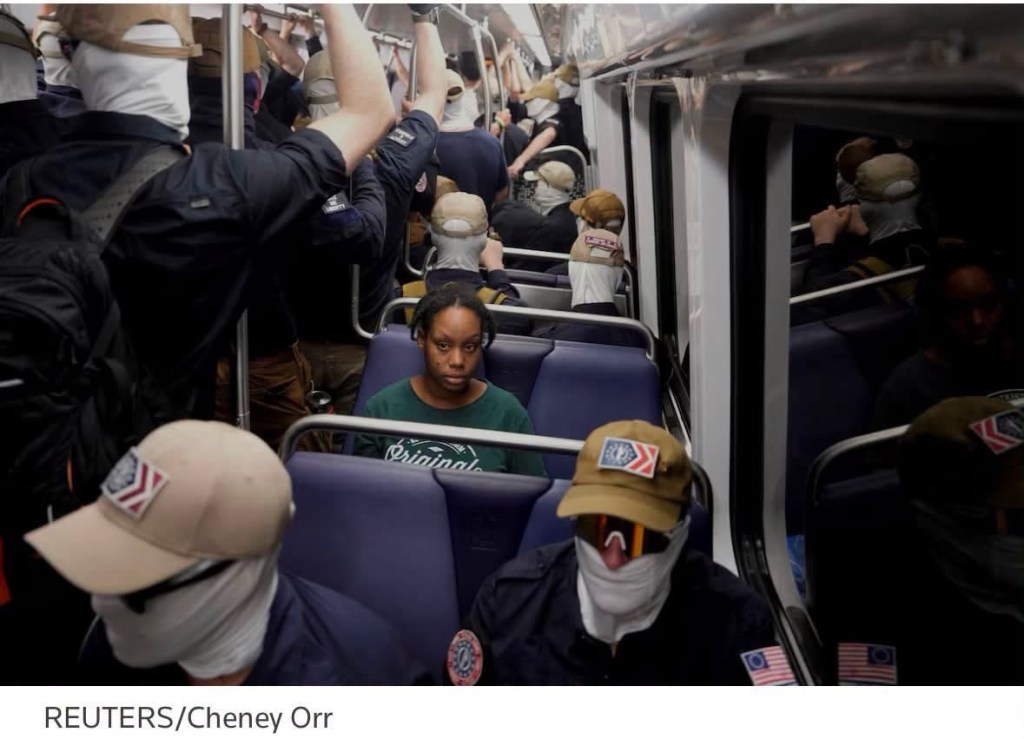
Faces Covered, Hearts Exposed: What This Train Car Teaches Us About Hate And Christian Nationalism

Courage vs Cowards

Today’s a new day! Here are my thoughts on this photo taken on the Metro in Washington, D.C. The following are my thoughts and opinions. If you happen to disagree with me, I encourage you to take it up with God.

Look at this photo. A young woman sits alone on a train, surrounded by dozens of men in matching uniforms, faces covered, patches bearing flags. She meets the camera’s eye. They refuse to be seen.

This image is a parable. And it’s the opposite of the Gospel.

The Gospel unmasks. Hate hides.

Jesus never hid His face. He wept publicly, prayed publicly, died publicly. “I have spoken openly to the world,” He told His accusers. (John 18:20)

Hate loves masks. It loves anonymity, mobs, and intimidation. Why? Because deeds done in darkness don’t survive the light (John 3:20). When an ideology needs to cover faces to deliver its message, it’s already confessed something about that message.

Christian Nationalism too often puts a mask on Jesus. It takes the crucified Savior and dresses Him in the uniform of earthly power. But Christ doesn’t need our flags stitched to His robe. “My kingdom is not of this world” (John 18:36). When we try to make it of this world, we end up looking like this train car: coercive, not compelling.

The Gospel draws near. Hate surrounds.

Notice the posture here. One person, isolated. Many others, standing, looming. That’s not how Jesus moved through crowds. 

He touched lepers when others stepped back. He invited Zacchaeus down from a tree when the crowd boxed him out. He stopped for the woman no one else would look at. The Gospel breaks circles of exclusion. Hate forms them.

Christian Nationalism, at its worst, baptizes “us vs. them.” It defines who belongs and who threatens. But the cross destroyed the dividing wall of hostility (Ephesians 2:14). If our faith needs an enemy to stay strong, it isn’t Christian faith. It’s civil religion with a cross necklace.

The Gospel sees the individual. Hate sees categories.

I don’t know the woman’s name in the photo. You don’t either. But God does. She isn’t a symbol. She’s a person made in His image (Genesis 1:27)

Movements built on hate don’t see people. They see demographics, threats, problems to solve. They make you afraid to sit alone on a train in your own city. 

Jesus’s first question to people was often, “What do you want me to do for you?” (Mark 10:51). He saw individuals. Christian Nationalism tends to see a “nation to save” and turns people into footnotes. When saving “America” matters more than loving the person next to you on the Metro, we’ve lost the plot.

So what do we do when the train car feels like the world?

Uncover our own faces: Confess where contempt has crept into our hearts. It’s easy to hate the masked men too. Jesus doesn’t give us that option. “Love your enemies” (Luke 6:27) includes them.

Sit with the isolated: Who in your life feels like that woman on the train? The Gospel moves us toward them, not away. Proximity kills caricatures.

Refuse the idols of power and fear: The early church changed the Roman Empire without voting, lobbying, or taking up swords. They did it by loving radically and dying well. Our witness still works that way.

Remember what we’re witnessing to: Not a Christian nation. A crucified Christ. “We preach Christ crucified… the power of God and the wisdom of God” (1 Corinthians 1:23-24). 

This photo should grieve us. Not just because of what it says about them, but because of what it reveals about us. Every one of those masked hearts was knit together by God. Every one of them is someone Christ died for. So is she. So are you. So am I.

Hate says, “Cover your face and find your strength in numbers.” 

Jesus says, “Take up your cross and find your life by losing it.”

The train is still running. The choice is still ours. Which kingdom will we board? ~OC

God, What Are You Trying To Teach Me?

Today’s a new day!

Over the past twenty-plus years, I have walked through one of the most difficult journeys of my life. There have been diagnoses I never expected, hospital stays, surgeries, treatments, setbacks, moments of uncertainty, and seasons where I had no idea what tomorrow would bring.

People have often asked me, “Have you ever asked God, ‘Why me?'”

My answer has always been the same.

No.

Not because there is anything wrong with asking that question. In fact, many faithful men and women throughout Scripture poured out their hearts before God. They asked difficult questions. They lamented. They cried. They wrestled with pain. God is not afraid of our honest questions.

But for me personally, “Why me?” was never the question God placed on my heart.

Instead, from the very beginning of this journey, another question kept rising within me:

“God, what are You trying to teach me in this season?”

That simple shift changed everything.

Instead of only looking for an explanation, I began looking for His presence.

Instead of demanding answers, I started seeking wisdom.

Instead of focusing only on what I had lost, I began discovering what God was building inside of me.

Looking back over these twenty-plus years, I realize that some of life’s greatest lessons weren’t learned on the mountaintops. They were learned in hospital rooms, waiting rooms, sleepless nights, rehabilitation sessions, and quiet moments when all I could do was trust Jesus.

So, what has God taught me?

I’m glad you asked.

God has taught me that my identity is not found in my health but in Him.

When your body begins to fail, you quickly discover that your worth isn’t measured by what you can accomplish. My value has never been based on my strength, my productivity, or my abilities. My identity has always been found in being a child of God.

God has taught me that weakness is not failure.

The world celebrates strength, but God’s Kingdom often works through weakness. It is often in our weakest moments that His strength shines the brightest. My limitations have become opportunities for His power to be displayed.

God has taught me patience.

Healing rarely happens on our timetable. Answers don’t always come when we want them. Waiting has never been easy, but waiting with Jesus has shaped my faith in ways instant answers never could.

God has taught me to treasure every single day.

When you’ve stared mortality in the face, ordinary days become extraordinary gifts. A sunrise. A conversation with my bride, Laura. A laugh with a friend. A walk outside. These are no longer ordinary moments—they are reminders of God’s goodness.

God has taught me compassion.

Pain has a way of opening your eyes to the suffering of others. I have learned to notice the people sitting quietly in waiting rooms, the caregivers who are exhausted, the families praying for miracles, and the person who simply needs someone to listen.

God has taught me that prayer changes me.

Sometimes God changes our circumstances.

Sometimes He changes us while we’re in them.

Both are miracles.

God has taught me that hope is never wasted.

Hope isn’t pretending everything is okay.

Hope is believing that Jesus is still faithful when everything around you says otherwise.

Hope is trusting His promises even when you cannot yet see His plan.

Most importantly…

God has taught me that He will never leave me.

Not once.

Not in the emergency room.

Not in the hospital room.

Not during surgery.

Not during the difficult diagnoses.

Not during the darkest nights.

Not during the countless doctor’s appointments.

Not during the moments when I didn’t know what the future would hold.

Jesus has been faithful every single step of the journey.

If you’re reading this while walking through your own difficult season, maybe your question today is, “God, why me?”

If that’s where you are, know this: God welcomes your honesty.

But perhaps, when you’re ready, you might also ask another question:

“Lord, what are You trying to teach me in this season?”

That question doesn’t minimize the pain.

It doesn’t erase the tears.

It doesn’t guarantee immediate answers.

But it does position our hearts to receive what God may be doing beneath the surface.

I’ve learned that while God may not always remove the storm immediately, He is always present within it. Sometimes the greatest miracle isn’t that our circumstances change overnight—it’s that Christ transforms us as we walk through them.

My health journey has been long.

It has been difficult.

It has been painful.

But by God’s grace, it has also been one of the greatest classrooms of my life.

And for every lesson, every trial, every unexpected detour, and every reminder that His grace is sufficient…

I simply say:

“Thank You, Jesus.

Now, Lord…

What would You like to teach me next?” ~OC

Blog at WordPress.com.

Up ↑